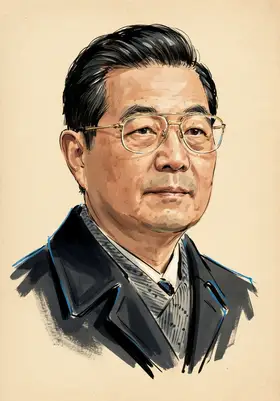
Hu Jintao on Wen Jiabao
TL;DR
Hu Jintao and Wen Jiabao formed the core leadership duo, largely representing a unified administrative approach.
Key Points
They jointly presided over the period known as the Hu-Wen Administration from 2003 to 2013.
Their working relationship involved attending joint high-level meetings, such as the Second Day Meeting of China's National People's Congress in March 2004.
The leadership style during their tenure is frequently characterized by observers as a form of collective leadership within the Politburo Standing Committee.
Summary
Hu Jintao, as General Secretary and President, worked closely with Premier Wen Jiabao, leading the country during the decade known as the Hu-Wen Administration. This partnership established a dualistic leadership structure where the Party leader and the State leader operated in tandem, often perceived as sharing a moderate political line focused on steady governance and economic growth. Evidence of their collaboration is seen in joint appearances and shared policy initiatives, indicating a functional, if not always perfectly aligned, executive structure at the apex of the Chinese Communist Party.
While generally viewed as a cohesive team, their relationship existed within the complex factional dynamics of the Politburo Standing Committee. Some analyses suggest Wen Jiabao, as the Premier responsible for the economy, sometimes championed more reformist stances than the consensus allowed, requiring the backing of the paramount leader. Their joint period is often retrospectively viewed as one of collective leadership, with both figures representing a pragmatic, consensus-seeking wing of the party apparatus during that era.
Frequently Asked Questions
Hu Jintao and Wen Jiabao functioned as the top two leaders of China, with Hu serving as the Party General Secretary and President, and Wen as the Premier. This relationship defined the Hu-Wen Administration, suggesting a necessary level of cooperation for governing during that era, according to historical analysis. They often appeared together at major state events, indicating a unified executive front.
While they formed the core of the leadership, the exact nature of their personal alliance remains debated among political analysts, according to commentary on their era. Hu Jintao led the Party and Military, while Wen Jiabao managed the State Council, showing a division of roles expected in the Chinese political structure. Their long tenure suggests a baseline level of functional political alignment was necessary to maintain control.
Some suggest that Wen Jiabao, in his role as Premier, sometimes pushed for more aggressive reforms than the consensus within the leadership, including the paramount leader, allowed. Reports indicate that the ability of the two to push through certain policies reflected a shared pragmatic approach to managing China's rapid development. This dynamic is often analyzed when discussing the political constraints on both men during their time in power.
Sources9
Hu–Wen Administration
Adam Tooze tweet on Hu-Wen era
Question about rumors surrounding Wen Jiabao and Xi Jinping
Hu Jintao and Wen Jiabao: The Reformers Who Couldn’t Reform China
China's leadership transition: Hu Jintao steps down
The Hu-Wen Administration: A Decade of Contradictions
Chinese Premier Wen Jiabao and President Hu Jintao attend the second day meeting of China's National People's Congress
Hu-Wen Leadership Six Months In
Making Sense of the Hu-Wen Era
* This is not an exhaustive list of sources.