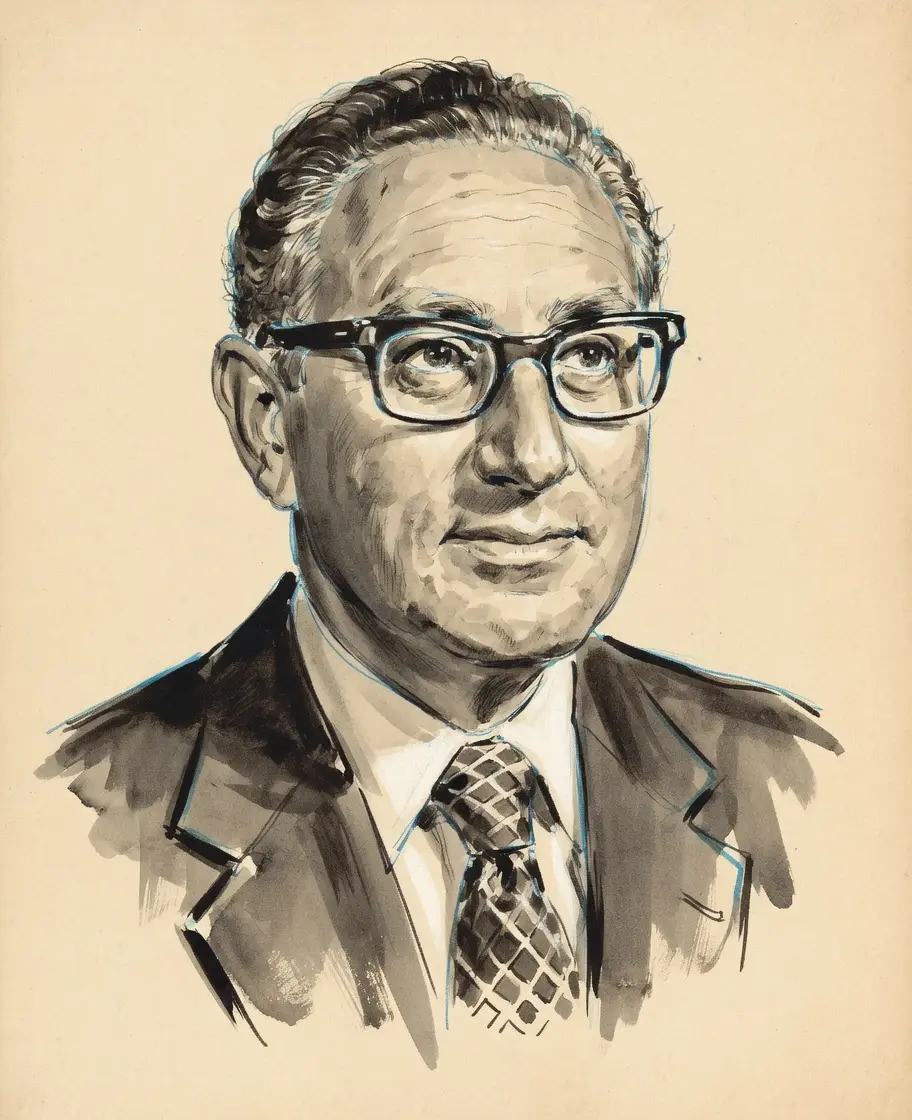
Henry Kissinger on Nuclear Weapons
TL;DR
Henry Kissinger views nuclear weapons as a strategic necessity that requires careful management to avoid catastrophic, disproportionate use in conflict.
Key Points
He opposed the Eisenhower Administration's policy of massive nuclear retaliation, arguing for a flexible response involving tactical nuclear weapons in limited conflicts.
He played a role in negotiating the first agreement to limit U.S. and Soviet nuclear weapons through the SALT I accord in 1972.
In 2010, he unequivocally recommended the Senate's ratification of the New START Treaty to continue reducing nuclear arsenals between the U.S. and Russia.
Summary
Henry Kissinger established himself as a major strategic thinker with his 1957 book, Nuclear Weapons and Foreign Policy, which argued against the policy of massive nuclear retaliation to any Soviet aggression. He advocated for a more flexible response that incorporated the possibility of using tactical nuclear weapons for clearly defined political objectives, maintaining that the sheer destructiveness of modern weapons made total war unthinkable for rational actors. This concept sought to create a political relationship between the power available and the foreign policy goals being pursued, aiming for deterrence rather than annihilation.
Throughout his career, he prioritized controlling and reducing strategic arms to prevent nuclear confrontation, viewing the proliferation of these weapons as an overarching strategic problem that multiplies confrontation risks. He participated in negotiating the SALT I accord and, later, supported the New START Treaty as a continuation of necessary bilateral dialogue to enhance transparency and stability between major nuclear powers. His position emphasizes that while deterrence remains essential, established nuclear powers must work to defuse regional conflicts that tempt new states toward acquisition, recognizing the inherent dangers of any use.
Frequently Asked Questions
Henry Kissinger views nuclear weapons as an inescapable reality of international relations that demands a strategy of controlled deterrence. He believed that any actual use would result in disproportionate devastation, necessitating careful political calculations to avoid escalation beyond foreseeable foreign policy objectives.
Kissinger analyzed the concept of limited nuclear war in his early writings, suggesting tactical nuclear weapons could be used in conflicts to avoid the finality of all-out war. He proposed military tactics centered on small, highly mobile units to achieve specific political goals rather than outright annihilation of the opponent.
Yes, Henry Kissinger has a record of supporting strategic arms control, stemming from his involvement in negotiating SALT I. He later stated that arms control is a non-partisan issue and recommended ratification of the New START Treaty in 2010.
Sources9
Speech by Henry Kissinger 2009 - Munich Security Conference
Henry Kissinger: “Arms control is not a bi-partisan issue, it is a non-partisan issue”
Nuclear Weapons and Foreign Policy | work by Kissinger | Britannica
Foreign Relations of the United States, 1969–1976, Volume E–14, Part 2, Documents on Arms Control and Nonproliferation, 1973–1976
Israeli Nuclear Program: Memo to President Nixon from Henry Kissinger, 7/16/69
Kissinger's role in avoiding nuclear war, and the key part Australia played | The Strategist
Nuclear Weapons and Foreign Policy, by Henry A. Kissinger (1957)
Nuclear Weapons and Foreign Policy, by Henry A. Kissinger; Limited War: The Challenge to American Strategy, by Robert Endicott O – Commentary Magazine
The Kissingerian view of limited nuclear war as naval warfare, and small nuclear unit tactics. An introduction. : r/CredibleDefense
* This is not an exhaustive list of sources.