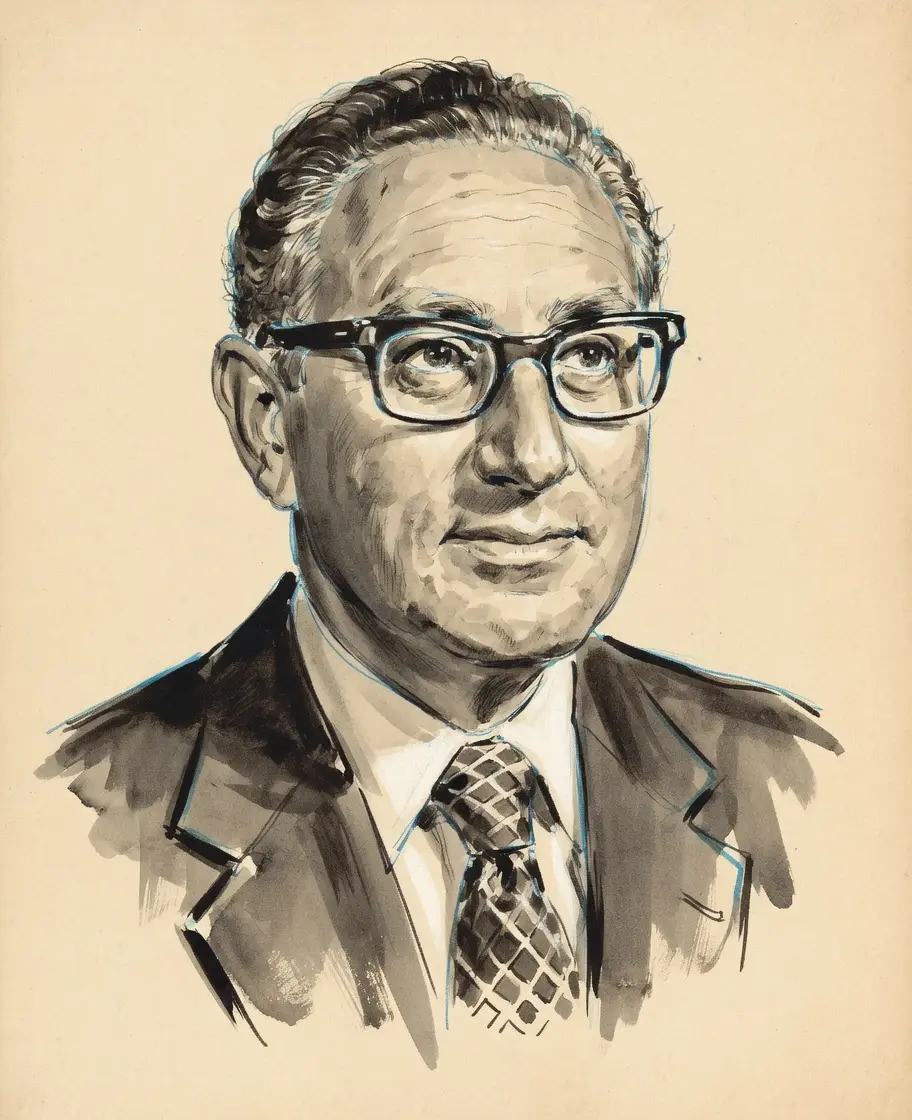
Henry Kissinger on Leadership
TL;DR
Effective leadership demands balancing historical analysis with intuitive grasp of future direction to set and execute world strategy.
Key Points
Effective leaders must possess both courage and strength of character, which are crucial qualities for political leaders.
He defined six specific leadership strategies exemplified by his case studies: humility (Adenauer), will (de Gaulle), equilibrium (Nixon), transcendence (Sadat), excellence (Lee Kuan Yew), and conviction (Thatcher).
Kissinger expressed concern that the shift toward visual culture via the internet risks eroding analytical ability, making it harder for thoughtful leaders to develop their capabilities.
Summary
Henry Kissinger's position on leadership, primarily detailed in his book Leadership: Six Studies in World Strategy, centers on the necessity of leaders operating at the intersection of two critical axes: the past versus the future, and the people's abiding values versus their aspirations. He posits that the primary task for any leader is rigorous analysis, starting with a realistic assessment of their society's history and capacities. Following this analysis, leaders must successfully balance established knowledge from the past with inherent uncertainty about the future, utilizing an intuitive grasp to set objectives and formulate a comprehensive strategy for their nation in the international arena.
He further categorizes transformational leaders into two archetypes: the statesman, who manages circumstances while tempering vision with wariness and limits, and the prophet, who is driven by an imperative vision and distrusts gradualism. Kissinger analyzed six 20th-century figures—Konrad Adenauer, Charles de Gaulle, Richard Nixon, Anwar Sadat, Lee Kuan Yew, and Margaret Thatcher—finding that the most significant leaders successfully transcended their inherited circumstances by employing a synthesis of these styles. He suggests that modern challenges, exacerbated by media trends like immediacy and polarization, threaten the development of future leaders who lack the traditional humanistic education necessary for this complex strategic reasoning.
Key Quotes
“Strategy' describes the conclusion a leader reaches under these conditions of scarcity, temporality, competition and fluidity.”
“Leaders think and act at the intersection of two axes: the first, between the past and the future; the second, between the abiding values and aspirations of those they lead.
Frequently Asked Questions
Henry Kissinger views leadership as essential during transitions, requiring leaders to operate at the intersection of past/future and values/aspirations. He stresses that effective leaders must analyze their society realistically, then use intuition to set objectives and develop a guiding world strategy.
Kissinger distinguishes between the statesman and the prophet. The statesman seeks to manage circumstances while tempering vision with caution, whereas the prophet is driven by an imperative vision and distrusts gradualism, aiming to transcend the status quo.
Yes, Henry Kissinger dedicated a study to Richard Nixon, whom he analyzed as employing a "strategy of equilibrium." This involved balancing power to achieve strategic goals like exiting the Vietnam War and opening relations with China.
Sources8
Kissinger on Leadership: A Realist in Surreal Times
Leadership: Six Studies in World Strategy - Signed – Nixon Library Museum Store
Leadership: Six Studies in World Strategy - Wikipedia
What Henry Kissinger Says About the Essence of “Leadership” | by Mark Looi | Medium
Henry Kissinger on Leadership: Six Studies in World Strategy | The Leading Blog
Leadership: Six Studies in World Strategy by Henry Kissinger - Providence
Leadership Quotes by Henry Kissinger - Goodreads
Leadership by Henry Kissinger - by LENGDUNG TUNGCHAMMA
* This is not an exhaustive list of sources.