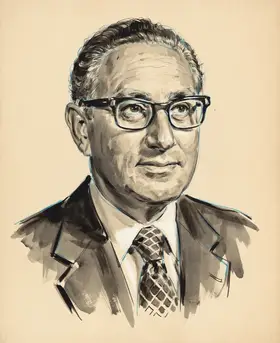
Henry Kissinger on Iran
TL;DR
Henry Kissinger strongly supported the Shah of Iran as a key strategic ally but feared post-revolution Iran's anti-Western ambitions.
Key Points
He deemed Iranian-Saudi cooperation essential but noted Arab fears of Iranian colonialism in the Gulf in 1973.
In 1974, he assured the Shah that the US did not want confrontation over oil prices but was planning for military action if an embargo occurred.
He asserted in 2014 that Iran was a bigger problem than ISIS due to its potential to reconstruct a 'Shia belt' empire.
Summary
Henry Kissinger, during his tenure as National Security Advisor and Secretary of State, strongly supported the Shah of Iran as the indispensable guardian of American power in the Persian Gulf throughout the 1970s. He viewed the Shah as a vital counterweight against Soviet influence and worked to deepen the bilateral relationship, even planning for military action in case of an oil embargo by the Shah's regime. Kissinger's policy involved unconditional support and significant military armament of Iran.
Following the 1979 Iranian Revolution, Kissinger's position shifted to recognizing the new clerical regime as a strategic threat; he later expressed concern that the post-revolution Islamic Republic sought to undermine the Westphalian system and rebuild a Persian Empire under a Shia label. He considered the Islamic Republic to be a greater problem than ISIS at one point, emphasizing the need for a clear US position on its nuclear ambitions.
Frequently Asked Questions
During his time in office, Henry Kissinger viewed the Shah's Iran as a strong, indispensable regional ally for the United States in the Cold War context. This stance was rooted in geopolitical strategy, aiming to balance Soviet influence in the Middle East. However, after the revolution, he viewed the successor regime as a major strategic challenge.
Yes, Henry Kissinger expressed significant concern regarding the potential for Iran to develop nuclear weaponry after 2014. He warned that if negotiations failed, the proliferation of nuclear weapons in Iran would lead to a completely different and more dangerous regional security environment.
Henry Kissinger engaged in extensive discussions with the Shah regarding high oil prices, aiming to prevent confrontation and seeking the Shah's recommendation for OPEC price freezes in late 1974. He also confidentially informed the Shah that the US was planning for military action should another oil embargo occur.
Sources7
Message From Secretary of State Kissinger to the President's Deputy Assistant for National Security Affairs (Scowcroft)
A Conversation with Henry Kissinger
Quote by Henry Kissinger: “With Iran's revolution, an Islamist movement dedicated to overthrowing the Westphalian system gained control over a modern state...” from World Order
Nixon, Kissinger, and the Shah: The United States and Iran in the Cold War
The myth of Iranian hegemony
The Disastrous History of Henry Kissinger's Policies in the Middle East
* This is not an exhaustive list of sources.