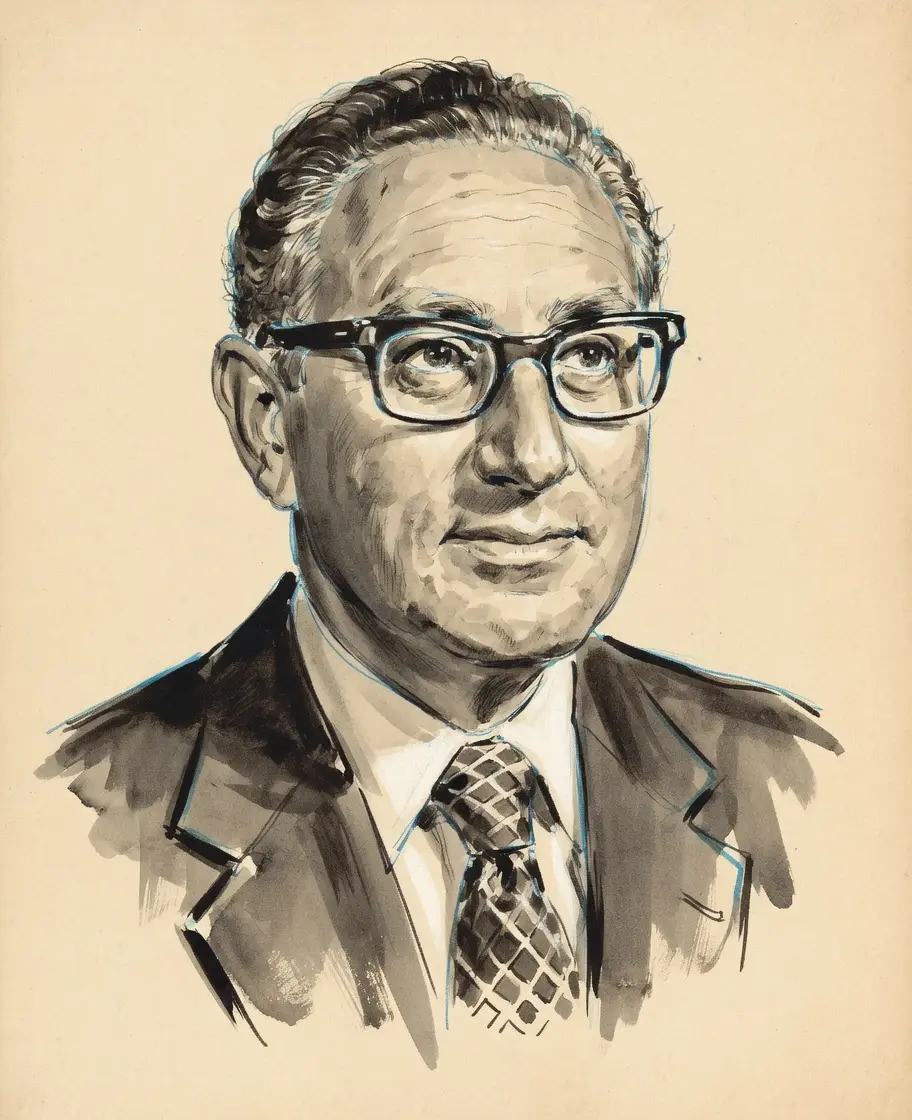
Henry Kissinger on Communism
TL;DR
Henry Kissinger viewed Communism as a structural revolutionary force that required pragmatic containment and engagement to manage global instability.
Key Points
He viewed the China of the early 1970s not as a pure Communist state but as a one-party state lacking a firm ideological foundation by the early 2000s.
Early in his career, he argued the U.S. should go on the spiritual offensive, identifying with freedom rather than just justifying actions based on the communist threat.
He believed that Communism succeeded in some new countries because it offered a doctrine of substantive change and a rationale for holding onto power after independence.
Summary
Henry Kissinger's position on Communism was rooted in a pragmatic assessment of it as a fundamental, structural, and revolutionary force in international affairs. In his view, ideological conflict inherent in Communism merged state divisions with internal national divisions, making diplomacy more difficult because parties spoke different political languages. He recognized the appeal of Marxism in developing nations as a doctrine capable of providing legitimacy for the massive sacrifices required for capital formation when traditional legitimacy was absent. The core challenge for the United States was not simply to defeat the ideology everywhere, but to manage the bipolar military reality it created, focusing on geopolitical changes rather than solely on Soviet intentions.
His approach evolved toward a strategy of linking political and strategic issues, notably through détente with the Soviet Union and establishing relations with the People's Republic of China. He saw the Soviet system as rigid and stagnant over the historical period, believing a long peace would ultimately benefit the West more than the Soviet Union. While vehemently opposing Communist expansion, especially through proxy forces, he argued against an undifferentiated global resistance to every change. He maintained that the contest with Communism was ultimately about freedom and values, cautioning against defining the struggle purely in economic terms, as this misunderstood its idealistic appeal in the developing world.
Key Quotes
We have our view that we wanted to link political and strategic issues together, and we moved at a very deliberate pace.
It is one of history's ironies that Communism, advertised as a classless society, tended to breed a privileged class of feudal proportions.
Frequently Asked Questions
Henry Kissinger fundamentally viewed Communism as a revolutionary force that destabilized the international system by merging ideological conflict with state boundaries. His core approach was pragmatic antagonism, necessitating containment of its expansion while simultaneously engaging with Communist powers like the Soviet Union and China to manage the risks of a bipolar world.
He did not necessarily believe the Soviet system would last forever, but he anticipated that the bipolar balance of power would endure for a long time. He thought the Eastern European satellite states would gradually edge out of the Soviet camp, but expected this process to take much longer than it ultimately did.
Kissinger distinguished China from the Soviet model, evolving to view it as a one-party state without a firm ideological foundation by the early 2000s, more comparable to Mexico under the PRI than Stalin's Russia. This view supported his policy of opening relations to exploit the Sino-Soviet split.
Sources6
Kissinger The Freedom Fighter
INTERVIEW WITH HENRY KISSINGER
Did Henry Kissinger predict that the Cold War would last for centuries? : r/AskHistory
Foreign Relations of the United States, 1969–1976, Volume I, Foundations of Foreign Policy, 1969–1972 Document 4
Quote by Henry Kissinger: “It is one of history's ironies that Communism, advertised as a
Interviews - Henry Kissinger | Dangerous Straits | FRONTLINE | PBS
* This is not an exhaustive list of sources.