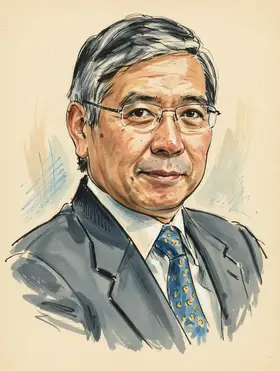
Haruhiko Kuroda on Bank of Japan
TL;DR
Haruhiko Kuroda championed aggressive monetary easing policies at the Bank of Japan to finally combat persistent deflation.
Key Points
He served as the 31st Governor of the Bank of Japan from March 20, 2013, until April 9, 2023.
Kuroda introduced the 'Quantitative and Qualitative Monetary Easing' policy upon assumption of office, targeting 2 percent inflation.
In early 2016, he guided the BOJ to adopt negative interest rates as part of its monetary policy framework.
Summary
Haruhiko Kuroda, during his tenure as the 31st governor of the Bank of Japan (BOJ) from March 2013 to April 2023, was the chief architect and proponent of exceptionally loose monetary policy aimed at achieving a sustainable 2 percent inflation target. He advocated for monetary easing well before his appointment, stating there was plenty of room for it, and upon taking office, implemented the ambitious Quantitative and Qualitative Monetary Easing (QQE) policy. This framework involved massive asset purchases, including government bonds and, at times, corporate bonds and stocks, with the goal of ending decades of deflationary stagnation by re-anchoring inflation expectations.
His tenure was marked by continually evolving and unconventional measures to stimulate the economy, including the introduction of negative interest rates in early 2016 as part of his 'QQE with Yield Curve Control' framework. While he credited these expansionary policies with regenerating the economy and significantly increasing employment, reaching the 2 percent inflation target proved to be a protracted struggle against deeply entrenched price-setting behaviors. After retiring, Kuroda indicated a shift, calling for rate hikes and tighter fiscal policy for the economy moving forward. [cite: 2, cite: 7]
Key Quotes
"Climate change risk is big and it will be the major risk problem in the next 20 to 30 years," ... "but in the next two to three years' time, the fragmentation of the world economy is what I'm the most concerned about."
Kuroda (2023, November 1) recalled how his goal had been to 'break the social norm, embedded during Japan's deflationary period, that prices and wages would not rise,' and stress the BOJ's determination to introduce powerful stimulus from the outset.
Frequently Asked Questions
Haruhiko Kuroda's main policy at the Bank of Japan was 'Quantitative and Qualitative Monetary Easing' (QQE), which he initiated in 2013. He aimed to overcome deflation by aggressively increasing the money supply through massive asset purchases to achieve a stable 2 percent inflation target. While he saw success in job growth, achieving the inflation goal remained a key challenge during his tenure.
Haruhiko Kuroda retired from his role as Governor of the Bank of Japan in April 2023 after serving for ten years. He was succeeded in the position by Kazuo Ueda. His departure followed a decade characterized by unprecedented monetary accommodation.
Yes, subsequent to his retirement, Haruhiko Kuroda has indicated a shift in his policy outlook, reportedly calling for rate hikes and tighter fiscal policy. This contrasts with his long-standing advocacy for continued, aggressive monetary easing during his time as Governor of the Bank of Japan.
Sources7
Ex-BOJ chief Kuroda calls for rate hikes, tighter fiscal policy
Haruhiko Kuroda - Wikipedia
Haruhiko Kuroda Biography
Haruhiko Kuroda : 日本銀行 Bank of Japan
Haruhiko Kuroda | GRIPS Faculty Directory
Haruhiko Kuroda - BIS
Ex-Governor of Bank of Japan Recounts Struggles to Curb Deflation | Columbia SIPA
* This is not an exhaustive list of sources.