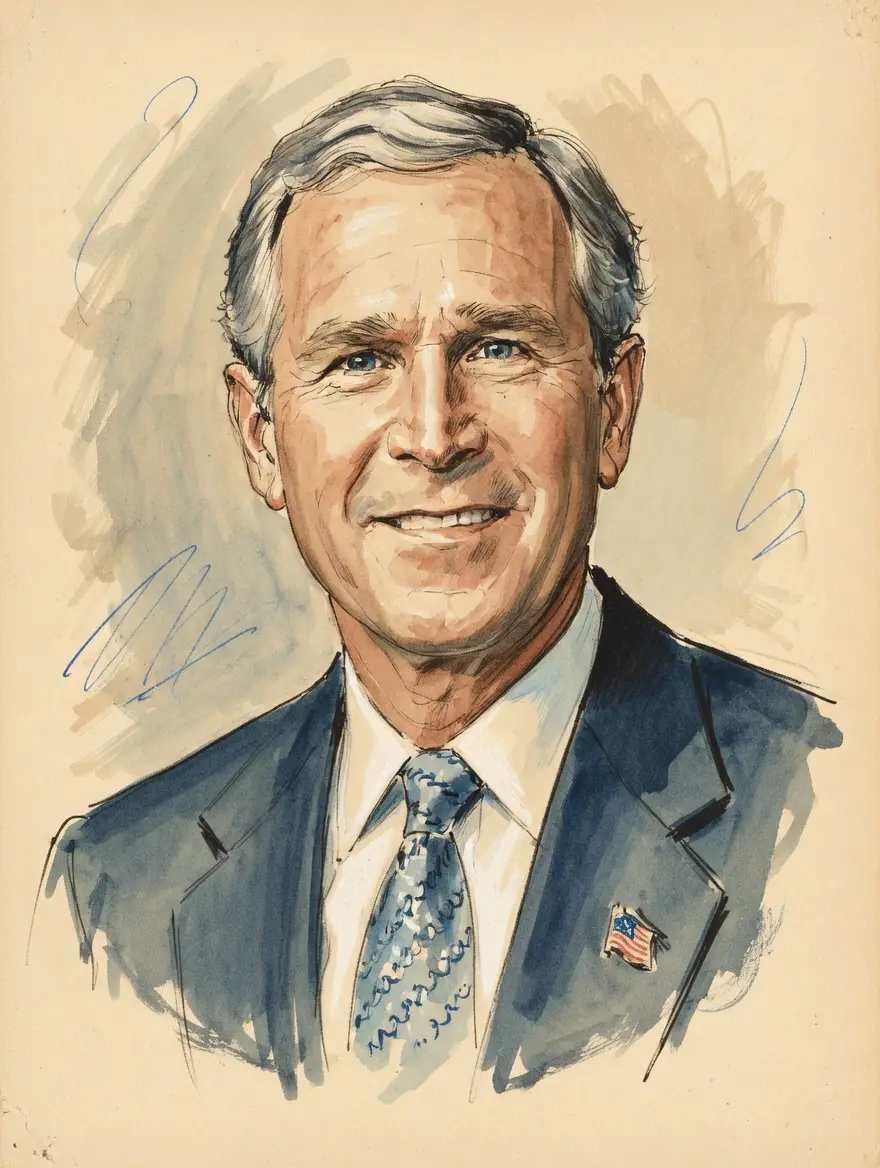
George W. Bush on Leadership
TL;DR
George W. Bush's leadership style was characterized by a bias for decisive action, moral certainty, and a personal approach to diplomacy.
Key Points
He defined leadership in terms of duty, honor, and country, emphasizing character and listening.
His post-9/11 crisis leadership was praised for uniting the nation, achieving a 90 percent approval rating.
His administration hosted the annual Forum on Leadership, focusing on topics like veteran transition and democratic citizenship.
Summary
George W. Bush's approach to leadership prioritized decisive action and moral clarity, especially following the September 11, 2001, terrorist attacks. He demonstrated a bias for action, often showing impatience with procedural delay and favoring intuitive, gut-based decisions over extensive deliberation, as seen in his insistence on quickly prosecuting the war on terrorism in Afghanistan. This style was underpinned by a strong moral certainty, partly rooted in his Christian faith, leading him to believe the United States had a divine commission to extend universal values like liberty globally. He viewed the world in personal terms, often forming bonds with foreign leaders based on trust and personal connection, which smoothed some diplomatic efforts but sometimes narrowed options when disagreements became personal.
This leadership profile included specific patterns of behavior that influenced major policy. For instance, his preference for clarity over complexity meant he sometimes resisted arguments that presented issues as nuanced or complex, and his bias for action led to swift decisions like the invasion of Iraq, despite skepticism from military planners and international bodies. While this approach provided firm leadership during crisis, scholars noted potential drawbacks: a risk of premature decisions, a failure to fully vet evidence, and a tendency to dismiss those who did not align with his administration's clear objectives, sometimes resulting in friction with allies who favored multilateralism.
Key Quotes
Leadership to me means duty, honor, country. It means character, and it means listening from time to time.
Frequently Asked Questions
George W. Bush viewed leadership as fundamentally tied to duty, honor, and country, stressing the importance of strong character. His tenure showed a preference for decisive action and moral certainty in decision-making, especially during times of crisis.
His style was marked by a strong bias for action and an impatience with lengthy procedural delays, often relying on his instincts. Furthermore, he approached international relations in a personalistic manner, valuing one-on-one trust with world leaders.
Yes, his leadership style reflected his deeply held Christian convictions, which informed his moral certainty regarding the righteousness of U.S. policy and its global mission. This faith led him to believe history was guided by a purpose set by God.
Sources5
Top moments from Forum on Leadership 2025 | George W. Bush
George W. Bush Quotes About Leadership | A-Z Quotes
The Art of Leadership: A President's Personal Diplomacy | George W. Bush Library
George W. Bush: Impact and Legacy | Miller Center
George W. Bush: Policy, Politics, and Personality - James P. Pfiffner
* This is not an exhaustive list of sources.