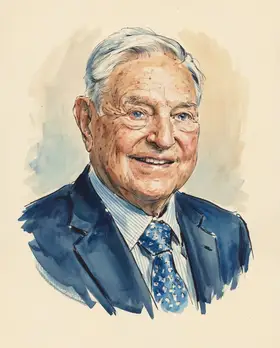
George Soros on Karl Popper
TL;DR
George Soros profoundly credits Karl Popper as his central intellectual influence and the inspiration for his philanthropic endeavors.
Key Points
Soros studied under Popper at the London School of Economics (LSE).
The name of his philanthropic network, the Open Society Foundations, directly reflects Popper's work.
Soros credits Popper's analysis with striking him "with the force of revelation" after experiencing Nazi and Communist rule in Hungary.
Summary
George Soros considers philosopher Karl Popper to be his primary intellectual influence, a connection that began when Soros studied at the London School of Economics. Soros was deeply impacted by Popper's work, particularly The Open Society and Its Enemies, which provided the philosophical foundation for his commitment to advancing open societies. The name of his philanthropic network, the Open Society Foundations, directly reflects Popper's concept, which argues against ideologies that claim a monopoly on truth and advocates for democratic governance, freedom of expression, and individual rights.
Although Soros adopted Popper's core concept, his application evolved to address new challenges facing open societies after the Cold War, such as the threat of unregulated capitalism and market fundamentalism, which he saw as the modern enemy in contrast to Popper's focus on totalitarianism. Soros acknowledged that while Popper provided the critical framework, the modern open society required a reformulation to be a more viable ideal for contemporary political action.
Frequently Asked Questions
George Soros regards Karl Popper as his central intellectual influence, crediting his philosophy for shaping his commitment to open societies. He was profoundly impacted by Popper's work, particularly The Open Society and Its Enemies, which he read as a student. Soros named his global philanthropic network after Popper's concept.
Yes, George Soros studied with Karl Popper at the London School of Economics (LSE). This encounter was a formative experience that cemented Popper's role as his greatest philosophical interlocutor. The association provided the foundation for Soros's future philanthropic endeavors.
While Soros adopted Popper's critique of totalitarian ideologies and the need for an open society, he later re-examined the concept. He argued that after the Cold War, the main threat shifted from communist dogma to the excesses of laissez-faire capitalism and market fundamentalism. Soros believed the concept needed reformulation to address these new challenges.
Sources10
George Soros - Open Society Foundations
George Soros, Karl Popper, and ironies of "The Open Society"
Sir Karl Popper and George Soros: Way Stations and Mirror Images of a Relationship
The Open Society Illusion: How George Soros and Karl Popper Undermined Capitalism, Funded Marxist Agendas, and Destabilized Nations
Soros and Popper: on fallibility, reflexivity, and the unity of method
Sir Karl Popper and George Soros: Way Stations and Mirror Images of a Relationship
The Open Society and Its Enemies - Wikipedia
The George Soros philosophy – and its fatal flaw
The Capitalist Threat - George Soros
The Open Society and its enemies: Karl Popper's legacy - LSE History
* This is not an exhaustive list of sources.