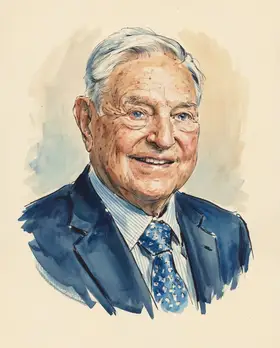
George Soros on Bubbles
TL;DR
George Soros views financial bubbles as self-reinforcing processes where misconceptions amplify real underlying trends until an unsustainable reversal occurs.
Key Points
He believes financial markets do not always reflect true economic fundamentals because expectations by traders distort them, contrasting with prevailing equilibrium theories.
In 2008, he suggested that rising oil prices had a bubble component superimposed on a strong upward trend, driven partly by institutional commodity index buying.
Soros's reflexivity theory suggests that self-reinforcing processes can push markets to extremes, resulting in boom-bust sequences that are endemic to the financial system.
Summary
George Soros's core position on bubbles is built upon his theory of reflexivity, which posits that market participants' views and the fundamentals of the market mutually influence each other in a two-way, self-reinforcing feedback loop. He stated that every bubble comprises a real underlying trend combined with a misconception about that trend; when these reinforce each other, the boom intensifies until the divergence from reality forces a recognition of the misconception, triggering a bust that is often sharper than the preceding boom.
He applied this framework to historical events like the 2008 housing crisis and, in testimony before a Senate committee in 2008, discussed the oil market, noting a bubble superimposed on a strong, real upward trend driven by factors like rising discovery costs. He argued that institutional commodity index buying exemplified a misconception-driven bubble element, drawing a parallel to the portfolio insurance craze before the 1987 stock market crash, and advocated for discouraging such index trading.
Frequently Asked Questions
George Soros's theory of reflexivity explains that bubbles occur when participants' biases reinforce a prevailing market trend, creating a positive feedback loop. This process causes market expectations to diverge significantly from reality until disillusionment sets in and the trend reverses sharply.
His core theory of reflexivity, introduced in the 1970s and expanded upon after the 2008 financial crisis, appears consistent. He continues to frame market movements, including bubbles, through this lens of self-reinforcing feedback loops.
He found commodity index buying eerily reminiscent of past market destabilizers and stated it was intellectually unsound and harmful. He suggested discouraging it and noted that varying margin requirements could help prevent asset bubbles from inflating.
Sources4
George Soros Testimony before the U.S. Senate Commerce Committee Oversight Hearing on FTC Advanced Rulemaking on Oil Market Manipulation
The Top 10 George Soros Investment Principles and Quotes
George Soros: Open Society, the Financial Crisis, and the Way Ahead
Reflexivity: Explaining Bubbles • Novel Investor
* This is not an exhaustive list of sources.