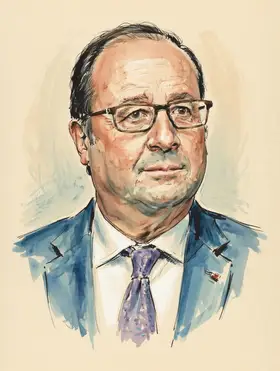
François Hollande on Left-Wing Politics
TL;DR
François Hollande champions a pragmatic, state-centric social democracy, often conflicting with more radical elements of the French left.
Key Points
He presided over the legalization of same-sex marriage during his presidency, a significant progressive social reform.
Hollande's administration implemented labor market reforms like the El Khomri law, which increased employer power, leading to left-wing protests.
He advocates for a unity of the Left around a social democratic orientation, believing the radical left cannot secure an outright majority.
Summary
François Hollande's position on Left-Wing Politics is defined by his commitment to a pragmatic, state-focused social democracy, contrasting sharply with the more radical, 'people'-centric approach of figures like Jean-Luc Mélenchon. As a former First Secretary of the Socialist Party (PS), his tenure was marked by an attempt to balance progressive social reforms, such as legalizing same-sex marriage, with the economic constraints he perceived, which he often framed as the "wall of money." This orientation saw him govern on a platform that accommodated European Union dictates on austerity, a move criticized by the left for betraying core socialist principles, leading to a significant defection of the party's left-wing voters.
This historical trajectory has led to an evolution in his political thought, which he articulated in his book, The Challenge of Governing. He argues that the left can only achieve progress through state power and must temper radical expectations to avoid being crushed by financial and institutional resistance, drawing lessons from Mitterrand's pivot towards austerity. This perspective positions him as defending the established institutions and the necessary compromises of governance, viewing the protection of institutions as essential, which places him at odds with those who advocate for more fundamental ruptures with the existing economic order.
Frequently Asked Questions
François Hollande believes the Left must unite around a pragmatic social democratic orientation to achieve electoral victory, as detailed in his book The Challenge of Governing. According to an analysis of his views, he asserts that the radical left cannot win or successfully bring the entire Left into a governing coalition. He sees accommodation with institutional realities as necessary for any meaningful progress.
Hollande's governance was marked by an accommodation with austerity demands from the EU and a perceived failure to challenge finance capital, which disappointed the more anti-capitalist segments of the Left. This policy pivot saw the Socialist Party's vote collapse, as noted in commentary from 2024. His insistence that he "coulda been a contender" but folded under pressure is a key point of contention for his critics on the further Left.
No, François Hollande fundamentally disagrees with the more radical elements, such as those associated with Jean-Luc Mélenchon's movement. Where Mélenchon identifies with 'the people' as a collective actor seeking rupture, Hollande identifies with the state and the necessity of 'governing' within existing economic constraints. This tension dates back to internal party battles within the Socialist Party decades ago.
Sources4
The Legacy of François Hollande: A President Who Defied Normalcy
The resurgence of the European left
Mélenchon vs. Hollande
As Populism Strengthens In Europe, A Future For Social Democrats Fades
* This is not an exhaustive list of sources.