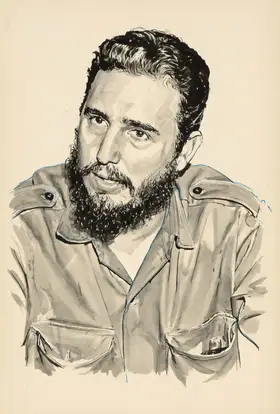
Fidel Castro on Socialism
TL;DR
Fidel Castro viewed socialism as the only viable path for humanity's progress beyond capitalist competition.
Key Points
He publicly identified as a Marxist-Leninist from December 1961 onward, viewing it as the revolutionary movement of the working class.
His administration nationalized industry and businesses, implementing socialist reforms that expanded healthcare and education access across Cuban society.
He believed building socialism required the work of free men and women acting voluntarily, despite his government's later authoritarian structure.
Summary
Fidel Castro definitively positioned himself as a Marxist-Leninist, openly declaring this ideology in December 1961, which solidified his alignment against the United States. Under his governance, the Cuban state fundamentally transformed into a one-party communist system, marked by the comprehensive nationalization of industry and business, alongside the implementation of sweeping socialist reforms across society. He asserted that economic and social progress was impossible under capitalism, viewing socialism as the necessary future for humanity, an idea he detailed in works like In Defense of Socialism. The implementation of this system involved central economic planning and significant state control over various sectors, justified as necessary for collective well-being and national sovereignty.
His commitment to this path was reinforced by external pressures, such as the US embargo, but was also driven by his own political agency and affinity for the centralized control a Soviet-style system conferred. While initially cautious about publicly adopting the 'communist' label to broaden his base during the revolution, his alignment became explicit following the Bay of Pigs Invasion, which he framed as an attack against his socialist revolution. He maintained this socialist orientation throughout his rule, even during the post-Soviet "Special Period," adapting tactics while insisting on defending socialist ideals against neoliberal global forces.
Frequently Asked Questions
Fidel Castro openly declared himself a Marxist-Leninist during a televised address on December 2, 1961, according to historical accounts. He stated that Marxism or scientific socialism had become the revolutionary movement of the working class. This declaration confirmed the political trajectory that many US officials had already suspected after his revolution.
According to Fidel Castro, a country could be considered socialist if its means of production were controlled by the state. This view emphasized the method of distribution over the specific nature of the ruling power structure. He articulated this stance in speeches and writings, such as in 'In Defense of Socialism,' published in 1989.
Yes, Fidel Castro's public articulation of his socialist commitment evolved; he was cautious about using the term 'communist' early in his rule (1959) to maintain a broad coalition. However, his ideological foundation, rooted in Marxist readings, became explicit by 1961, and he later adapted reform strategies during the economic 'Special Period' while maintaining core socialist principles, as noted in his later reflections.
Sources7
Fidel Castro | International Socialist Review
The Nature of Cuban Socialism
Fidel Castro declares himself a Marxist-Leninist | December 2, 1961
In Defense of Socialism | Pathfinder Press
Castro: 'Building socialism is the work of free men and women' – The Militant
In Defense of Socialism: Four speeches on the 30th anniversary of the Cuban revolution | Goodreads
Fidel Castro - Wikipedia
* This is not an exhaustive list of sources.