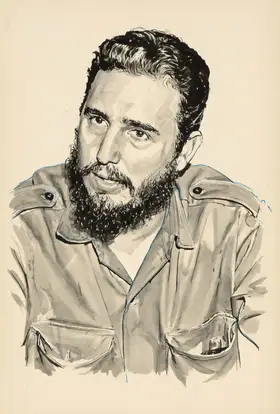
Fidel Castro on Religion
TL;DR
Fidel Castro's view evolved from early revolutionary antagonism to later state secularism and cautious interfaith dialogue.
Key Points
Public expressions of religion were banned in Cuba between 1961 and 1992 following initial post-revolutionary conflict with the Church.
In 1992, he amended the constitution to change Cuba’s designation from an atheist state to a secular state, allowing open religious practice.
He expressed a belief that Christian teachings contained "a sense of social justice" and that he was a Christian based on "social vision" by 2009.
Summary
Fidel Castro's stance on religion underwent a significant transformation throughout his leadership of Cuba. Initially, following the 1959 revolution, his Marxist-Leninist government adopted policies hostile to organized religion, leading to restrictions, propaganda against the faithful, and the banning of public religious expression, including the abolition of Christmas as a holiday in 1969. This period of antagonism stemmed from the perceived alliance of the conservative Catholic Church with the pre-revolutionary elite and counter-revolutionary forces, exemplified by the Church’s support following the Bay of Pigs invasion. Consequently, for a time, Cuba was officially an atheist state, and membership in the Communist Party was prohibited for believers in God.
However, Castro's position moderated considerably, particularly after 1992, driven by factors like the influence of Liberation Theology and high-level dialogues with religious figures like Pope John Paul II. This shift saw the state transition from 'atheist' to 'secular' and saw the re-establishment of religious freedom, permitting open practice and the return of Christmas as a public holiday in 1998. In later life, he expressed respect for Christian values, stating he was a Christian in terms of 'social vision' and even suggesting the teachings of Christ could form a 'radical Socialist programme'. Despite this late-stage openness, the state maintained control over religious organizations and could still employ repressive tactics against dissenting believers.
Key Quotes
I've said that we [Christians and Communists] should do something more than coexist in peace. There ought to be closer, better relations; there should even be cooperation between the revolution and the churches, because they can't represent the landowners, the bourgeois, and the rich any more…
Frequently Asked Questions
Fidel Castro's initial position following the 1959 revolution was antagonistic toward organized religion, viewing it as allied with conservative, counter-revolutionary classes. This led to restrictions, church closures, and the suppression of public religious expression for several decades, with Cuba being declared an atheist state. This early stance was influenced by the Church's perceived siding with the opposition after events like the Bay of Pigs.
Yes, Fidel Castro's stance evolved significantly over time, moving from antagonism to a later, cautious acceptance. Following dialogues with religious leaders and the rise of Liberation Theology, he allowed for greater religious freedom starting around 1992. He later stated he considered himself a Christian based on social vision, though the state retained secular authority.
Fidel Castro later argued there were no fundamental contradictions between the core aims of Christianity and socialism, as both sought the welfare of man. He stated that in organizing the Communist Party initially, believers were excluded due to circumstances and perceived counter-revolutionary risk, not simply as Catholics. In dialogue, he expressed that true Christians and Marxists could cooperate based on mutual honesty and conviction.
Sources6
Fidel Castro's War on Religion
Fidel and religion : Fidel Castro in conversation with Frei Betto on Marxism and Liberation theology
Religious views of Fidel Castro - Wikipedia
RBD2021: Fidel and Religion | Dean Dettloff
An excerpt from a speech that Fidel Castro gave on May Day, 1961 in Havana : r/RadicalChristianity
Fidel Castro's Failed Paradise – Religion & Liberty Online
* This is not an exhaustive list of sources.