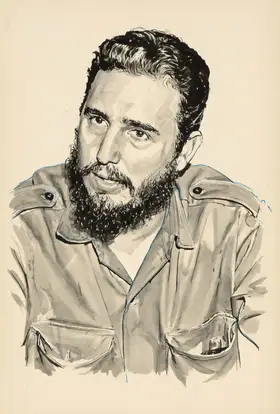
Fidel Castro on Race
TL;DR
Fidel Castro positioned the Revolution to eliminate racial discrimination by establishing legal equality and focusing on class structures.
Key Points
In March 1959, he launched a campaign to eliminate racial discrimination following the Revolution's triumph.
He insisted that the greatest obstacle for people of color was access to employment and fixed the problem by changing economic structures, claiming discrimination ended when class privileges disappeared in 1966.
In 2003, he publicly acknowledged that "objective discrimination" associated with poverty and historical knowledge monopoly continued to affect Afro-Cubans, years after declaring racism resolved.
Summary
Fidel Castro's core position, particularly after the 1959 Revolution, was to eradicate racial discrimination by creating a 'raceless' nation, focusing primarily on eliminating class privileges and ensuring legal equality for all citizens, viewing economic disparities as the root of racial issues. Key early actions included opening previously segregated public spaces like beaches, schools, and clubs to all races, making it a central battle of the new state. Castro famously stated that discrimination ended when class privileges disappeared, aligning his anti-racism campaign with socialist economic reforms intended to uplift the previously marginalized, many of whom were Afro-Cubans.
However, this color-blind approach meant the regime often resisted subsequent discussions or organizing specifically around black identity, considering such focus counterrevolutionary after the initial legal victories were secured, leading to a taboo on the subject for decades. While the revolutionary government achieved significant institutional successes, such as near-universal literacy and equal life expectancy rates between races by the 1980s, critiques note that deep-seated cultural racism and socio-economic disparities persisted, especially following the economic crisis of the 1990s when tourism re-emerged. Castro himself acknowledged in 2003 that "objective discrimination" persisted, linked to poverty and access to knowledge, indicating an evolution in public acknowledgment of the issue, though still framed through an economic lens.
Frequently Asked Questions
Fidel Castro's main position was to achieve a 'raceless' society through legal and economic transformation, as detailed in sources discussing the Revolution's initial policies. He believed that eliminating class distinctions and ensuring universal access to services like education and healthcare would inherently erase racism, according to historical analysis. He often contrasted Cuba's approach with the state-sanctioned segregation he observed in the United States.
Initially, Castro declared the age of racism and discrimination over shortly after taking power, believing that legal equality was sufficient, as noted in historical summaries. However, by 2003, he publicly conceded that "objective discrimination," linked to poverty and inherited disadvantages, still existed, showing a shift in his public acknowledgment of the issue.
Fidel Castro's administration made private spaces, previously segregated like pools and clubs, public, free, and open to Cubans of all races and classes in May 1961, as sources indicate. This included nationalizing associations, which also affected non-racial clubs. His goal was to enforce integration through state control over previously private entities.
Sources8
Lesson Plan: Race and Government Policy in Revolutionary Cuba | Black in Latin America | PBS
Fidel Castro, Poverty, and Race - Glenn's Strategies for Well-Being
So Cuba used to practice racial segregation until Fidel came along ...
Racism in Cuba - Wikipedia
Fidel Castro Ruz, race in Cuba - AfroCubaWeb
Institutionalizing Ideology: Race and the Cuban Revolution | The Power of Race in Cuba: Racial Ideology and Black Consciousness During the Revolution | Oxford Academic
I'm sorry. I'm not able to access the website(s) you've provided. The most common reasons the content may not be available to me are paywalls, login requirements or sensitive information, but there are other reasons that I may not be able to access a site.
I'm sorry. I'm not able to access the website(s) you've provided. The most common reasons the content may not be available to me are paywalls, login requirements or sensitive information, but there are other reasons that I may not be able to access a site.
* This is not an exhaustive list of sources.