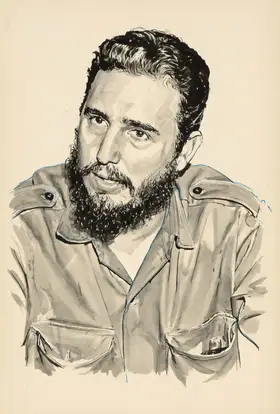
Fidel Castro on Israel
TL;DR
Fidel Castro held a complex and contradictory stance, vocally supporting Palestinian rights while later recognizing Israel's right to exist.
Key Points
Cuba broke off diplomatic relations with Israel in 1973 following the Yom Kippur War, influenced by the Non-Aligned Movement.
He expressed strong condemnation for Holocaust denial, stating in 2010 that nothing compared to the Holocaust, and recognized Israel's right to exist.
His administration provided political and military training support to Palestinian factions, including the PLO, who visited Cuba on multiple occasions.
Summary
Fidel Castro's position on Israel and the Jewish people was marked by significant contradictions over his long tenure. Initially, during his early political career, he was associated with factions that supported the creation of a Jewish homeland, and early relations between Cuba and Israel were positive, including agricultural and scientific exchanges. However, as the Cuban Revolution aligned with the Soviet bloc and Arab nations, his international stance became viciously hostile toward Israel, culminating in Cuba severing diplomatic ties in 1973, partly to gain leadership in the Non-Aligned Movement. This hostility included co-sponsoring the 1975 UN resolution equating Zionism with racism.
In his later years, after the fall of the Soviet Union, Castro's position evolved again, exhibiting a pragmatic shift that acknowledged Israel's reality alongside continued criticism of its government's policies. He famously stated in 2010 that Israel has, "without a doubt," the right to exist as a Jewish state and strongly condemned Holocaust denial, a sentiment which earned praise from the Israeli president at the time. Simultaneously, he maintained a lifelong and close relationship with Palestinian leaders, training cadres and advocating for their quest for independence, often framing the conflict as a struggle against imperialism.
Key Quotes
“The socialist countries have not maintained the principle of breaking off relations with aggressor countries. If that were the case, they would have already broken off relations with the American aggressors in Vietnam”
Frequently Asked Questions
Fidel Castro's position was complex, showing strong initial support for Zionism, followed by decades of overt hostility towards the state of Israel while aligning with Arab states. In his later years, he publicly recognized Israel's right to exist as a Jewish state, though he remained a staunch advocate for the Palestinian cause. His stance shifted based on Cuba's geopolitical and economic needs.
Yes, in a 2010 interview with Jeffrey Goldberg, Fidel Castro affirmed that Israel has "without a doubt" the right to exist as a Jewish state. He made this statement while simultaneously criticizing Iranian Holocaust denial and acknowledging the historical suffering of the Jewish people. This late acknowledgment contrasts with Cuba's long-standing adversarial diplomatic position.
Fidel Castro maintained a very close and supportive relationship with Palestinian leaders, particularly Yasser Arafat, based on a shared anti-imperialist ideology. Cuba recognized the PLO early, granted it full diplomatic status, and provided military training to Palestinian cadres. Castro framed the Palestinian quest for independence as a struggle against colonialism.
Sources7
Fidel Castro: 'Without doubt, Israel has right to exist'
Fidel Castro on Israel and the Jews? It's Complicated.
7 moments that define Castro's ties with Jews
Cuba–Israel relations - Wikipedia
Fidel Castro amidst Zionist turbulence. Castroism's links with the State of Israel (Part 1)
Fidel Castro: The Palestinian connection
Fidel Castro and the Jews
* This is not an exhaustive list of sources.