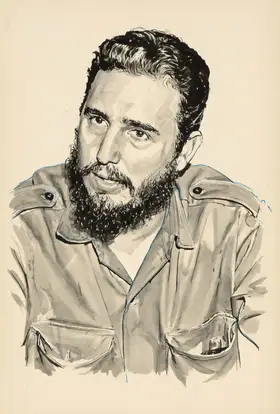
Fidel Castro on Imperialism
TL;DR
Fidel Castro viewed imperialism, primarily US-driven, as a predatory global system based on economic exploitation and political domination.
Key Points
He declared that 'The United States believes it has the right to decide the destiny of all peoples. That is the essence of imperialism' in September 1960.
In the Second Declaration of Havana (1962), he stated that imperialism 'cannot forgive a people that frees itself,' framing independence as the core conflict.
He described the US economic blockade against Cuba in the 1990s as 'an act of war against an entire people,' noting that economic blockades 'kill like bombs, but silently.'
Summary
Fidel Castro consistently denounced imperialism as the fundamental obstacle to the liberation and progress of subjugated peoples worldwide. He framed it not as a series of errors or excesses by specific leaders, but as the inherent and necessary structure of monopoly capitalism in its global expansion. Key evidence for this stance is found in his condemnation of the United States treating Latin America as a 'backyard' and his identification of imperialist aggression through invasion, economic blockade, and ideological manipulation.
This anti-imperialist vocation was heavily influenced by the thought of José Martí and later solidified by Marxist-Leninist theory after the Cuban Revolution. The implication of his position was a commitment to active international solidarity, demonstrated by supporting global liberation movements, as he stated Cuban fighters would support any revolutionary movement anywhere on earth. He believed that for developing nations, resisting this system, even through armed struggle, was the only path to true sovereignty and economic independence.
Key Quotes
“The United States believes it has the right to decide the destiny of all peoples. That is the essence of imperialism.”
“The enemy that threatens Cuba is the same enemy that threatens everyone else.”
“Imperialism cannot forgive a people that frees itself.”
Frequently Asked Questions
Fidel Castro viewed imperialism, particularly US imperialism, as a predatory, global system rooted in economic exploitation and the subjugation of other nations. He articulated this position throughout his career, seeing it as the central political and economic struggle of the contemporary era. He argued that only through revolutionary struggle and international solidarity could this system be overcome.
Yes, Fidel Castro consistently linked imperialism to economic motivations, stating that the desire for riches was the fundamental motive for imperial expansion since the discovery of America. He condemned imperial powers for seizing natural resources and exploiting human labor in weaker countries. This economic exploitation was, for him, enforced by imperial state power.
Fidel Castro advocated for active resistance, which included supporting revolutionary movements across the globe as part of an internationalist duty. He asserted that for Latin America, the struggle against imperialism and feudalism often required armed struggle as the 'fundamental way' to achieve liberation. He saw international solidarity as a vital counter-force to imperial power.
Sources10
15 Times Fidel Castro Blasted U.S Imperialism
Fidel Castro: 'The enemy that threatens Cuba is the same enemy that threatens everyone else', Tricontienntal Conference - 1966
Fidel Castro's anti-colonialist legacy
Fidel Castro speech on Marxism
Fidel Castro: imperialism and the 'brain drain'
Fidel Castro: Speech to the OLAS Conference (August 1967)
Fidel Castro: Second Declaration of Havana
Words in favor of Fidel Castro
Fidelismo - Wikipedia
* This is not an exhaustive list of sources.