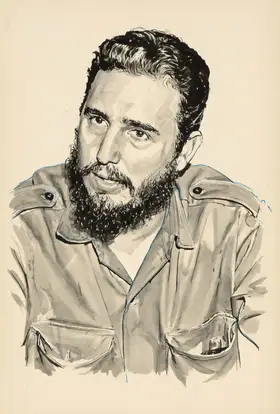
Fidel Castro on Communism
TL;DR
Fidel Castro was a committed Marxist-Leninist who oversaw the establishment of a one-party communist state in Cuba.
Key Points
He officially proclaimed his adherence to Marxism-Leninism on December 2, 1961.
Under his administration, Cuba was transformed into a one-party communist state starting from the mid-1960s.
He served as the First Secretary of the Communist Party of Cuba from 1965 until 2011.
Summary
Fidel Castro officially declared himself a Marxist-Leninist in December 1961, a pivotal moment that solidified the revolutionary government's ideological trajectory toward a Soviet-aligned, single-party communist system. This stance underpinned the sweeping socialist reforms implemented in Cuba, including the nationalization of industry and business, which fundamentally reshaped the nation's economic and social structure. He served as the leader of the Communist Party of Cuba from 1965 until 2011, demonstrating a long-term commitment to the ideology as the official doctrine of the Cuban state.
Though evolving from an initial focus on national liberation, Castro's adoption of Marxism-Leninism became the defining characteristic of his rule, shaping Cuban foreign policy and domestic governance for decades. While the system aimed for socialist ideals, later assessments indicated that the implemented model perpetuated significant economic hardship and limited personal freedoms within the country. His long tenure cemented Cuba's status as a highly centralized, ideologically committed communist state in the Western Hemisphere.
Key Quotes
The Cuban model doesn't even work for us anymore,
Frequently Asked Questions
Fidel Castro formally declared himself a Marxist-Leninist on December 2, 1961, according to historical accounts of his speeches. This declaration marked the formal ideological alignment of the Cuban Revolution with the principles of Communism.
While his initial focus was on national liberation, Fidel Castro’s core ideological commitment appeared steadfast once declared, as he served as the head of the Communist Party for decades. His adherence to Marxist-Leninist principles remained the official line for the duration of his leadership, as evidenced by his governance.
Fidel Castro led the implementation of socialist reforms throughout Cuban society, according to historical records of his administration. Key actions included the complete nationalization of major industries and businesses, establishing a one-party political structure.
Sources9
Castro declares himself a Marxist-Leninist - December 2, 1961
Fidel Castro - Wikipedia
Fidel Castro did an interview in 1959 where he explained the Cuban Revolution was not "communist" in the traditional sense. (1959)
Fidel Castro, Speech to the Cuban People: "I am a Marxist-Leninist"
Cuba, Castroism, and Communism, 1959-1966
The Legacy of Fidel Castro: How Communism Perpetuated Poverty and Misery in Cuba
Comandante: Fidel Castro and the Cold War
Fidel Castro: Cuban communism 'not working'
Fidel Castro
* This is not an exhaustive list of sources.