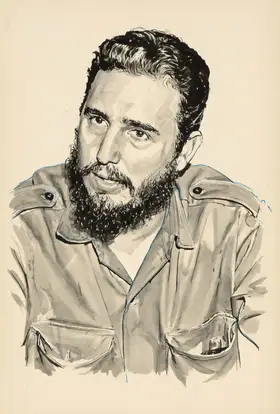
Fidel Castro on Christianity
TL;DR
Fidel Castro viewed Christianity's social vision as compatible with socialism but initially suppressed religious institutions, later showing more openness.
Key Points
He stated in 2009 that he considered himself a Christian based on his social vision, not religious doctrine.
Early in his regime, public expressions of religion were banned from 1961 to 1992, following conflict with the Church.
He restored Christmas Day as an official public holiday in December 1998, the first time since its abolition in 1969.
Summary
Fidel Castro expressed a complex relationship with Christianity, viewing it through the lens of social justice and revolutionary goals, particularly finding common ground with liberation theology. He famously stated that if called a Christian based on social vision, he would embrace the label, noting great coincidences between Christian teachings on humility and austerity and a revolutionary's life. He drew parallels between Christ's actions, like multiplying loaves and fishes, and socialist objectives to feed the people, suggesting Karl Marx could have subscribed to the Sermon on the Mount.
However, the historical context of his rule involved severe repression, as the government initially declared Cuba an atheist state, closed religious schools, expelled clergy, and banned Christmas for decades, viewing the established Catholic Church as allied with the rich and counterrevolutionaries. This stance softened significantly, especially after meetings with Popes, leading to the description of Cuba as secular rather than atheist by 1992, and the reinstatement of Christmas as a public holiday in 1998, although subtle discrimination against religious party members reportedly persisted.
Frequently Asked Questions
Fidel Castro believed there were significant areas of agreement between the social aims of Christianity and Communism, stating there were more coincidences than with capitalism. He often cited Christian teachings on humility, austerity, and option for the poor as aligning with revolutionary goals, according to his discussions with Frei Betto. He maintained this belief even while adhering to Marxist-Leninist ideology as president.
Yes, Fidel Castro's position on organized religion evolved over time, marked by initial conflict and later engagement. Initially, the government suppressed many religious institutions, leading to a period where the state was officially atheist. However, following meetings with papal figures, restrictions were loosened, and the country was reclassified as secular by 1992.
Fidel Castro argued that the teachings of Jesus Christ could be interpreted as advocating for a radical socialist program focused on helping the poor. He specifically referred to Christ multiplying the fish and loaves as a socialist act to feed the people. He believed Christ could formulate a socialist program, whether one was a believer or not.
Sources6
Christ, Marx and Che: Fidel Castro offers pope his religious views
Fidel Castro's War on Religion
Religion: Castro Looks At Christianity | TIME
Religious views of Fidel Castro - Wikipedia
RBD2021: Fidel and Religion | Dean Dettloff
Explaining The Castro Regime's Use of Christian Propaganda During The Cuban Revolution: 1959-1961
* This is not an exhaustive list of sources.