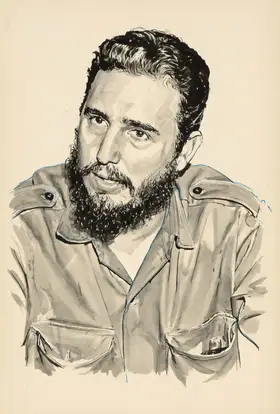
Fidel Castro
- Known for
- Cuban revolutionary leader, Marxist–Leninist head of state, Cold War figure
- Born in
- Birán, Cuba
- Education
- Doctor of Law, University of Havana
Fidel Castro defined Cuba for half a century, leading the 1959 Cuban Revolution from guerrilla fighter to Marxist–Leninist dictator. His rule was a polarizing mix of advancing social justice while suppressing dissent and maintaining a one-party state. He remains a towering, controversial figure in global anti-imperialist movements.
Signature Positions
Castro's leadership was characterized by a commitment to revolutionary socialism and deep suspicion of the United States:
- Communism/Socialism: Championed a Marxist–Leninist model, nationalizing industry and business to create the first one-party communist state in the Western Hemisphere.
- American Relations: Maintained an adversarial relationship with the US, leading to the Bay of Pigs Invasion and the Cuban Missile Crisis; consistently opposed US hegemony.
- Revolution: Strongly supported global revolutionary groups and Marxist governments, funding anti-imperialist movements in Latin America and Africa.
- Social Reforms: Prioritized universal healthcare and education, achieving significant social justice improvements, often at the expense of economic development.
- Religion: His stance on Christianity evolved from initial suspicion (labeling religious groups as counter-revolutionary) to acknowledging shared social justice precepts.
How Views Have Evolved
Castro's ideological stance evolved notably, particularly regarding economics and social issues.
He initially masked his Marxist-Leninist leanings to garner broad support after the revolution, but openly declared himself a Marxist in 1961 and moved to establish a fully socialist state, culminating in the banning of elections.
His view on Religion softened over time; while initially critical, he permitted the visit of Pope John Paul II in 1998 and later admitted the state's persecution of gay men in the 1960s and 70s was a 'great injustice'.
Notable Tensions
Castro’s rule presented several significant contradictions:
- Dictator vs. Democrat: Critics, like Samuel Farber, argued that despite the 1976 Constitution, real power rested solely with the Castro brothers and the Communist Party, rendering legislative bodies powerless.
- Anti-Imperialism vs. Soviet Dependence: While fiercely anti-US, Cuba became economically dependent on massive subsidies from the Soviet Union (and later Venezuela).
- Social Progress vs. Human Rights: While lauded for massive gains in healthcare and education, his regime suppressed freedom of expression and jailed political opponents.
- Personal Wealth: Despite espousing socialism, Forbes estimated his personal wealth in the hundreds of millions, based on control over state-owned enterprises.