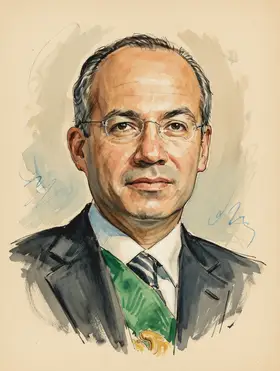
Felipe Calderón on Governance Assessment
TL;DR
Felipe Calderón's administration was associated with discussions around international governance indicators, yet context remains absent.
Key Points
Mexico was ranked in the 60.5 percentile for government effectiveness by the World Bank in 2009.
The Calderon administration pursued reforms aimed at increasing transparency, such as establishing COMEFER, which relates to regulatory quality, a dimension in governance assessments.
During his tenure, Mexico faced challenges in the 'Rule of Law' indicator, scoring in the 34.0 percentile in 2009, reflecting issues with contract enforcement, police, and the courts.
Summary
Felipe Calderón's presidency in Mexico coincided with an increased global focus on measuring governance, as evidenced by international reports that tracked metrics like 'government effectiveness' during his tenure. For instance, Mexico's percentile rank on the World Bank's government effectiveness indicator was noted in a 2011 analysis, suggesting his administration was operating within a framework where such governance assessments were becoming relevant for international benchmarking and development dialogue. However, the provided context, largely sourced from analyses of international governance indicators and Mexican PESTLE reports from his era, does not explicitly detail Calderón's personal or official stance on the methodology or implementation of Governance Assessment itself.
The broader literature from this period suggests that composite governance indicators, while widely cited, were subject to significant criticism regarding their clarity, stability of meaning, and potential biases toward business perceptions. In the context of Mexico's economic and security challenges, particularly the fight against drug cartels and efforts to improve regulatory quality, the government's focus was on domestic reforms and international trade agreements. The absence of direct statements from Calderón or his administration regarding the specific academic or political merits of Governance Assessment tools suggests a practical engagement with the results of such assessments (like comparative rankings) rather than a philosophical stance on the process of governance assessment.
Frequently Asked Questions
The provided context does not detail Felipe Calderón's personal or official position on the methodology of Governance Assessment. However, his administration operated during a time when Mexico’s performance in international governance indicators was being publicly tracked and reported on by bodies like the World Bank. This suggests a pragmatic awareness of the importance placed on these metrics internationally.
Mexico's governance was externally assessed through various dimensions, including government effectiveness, rule of law, and control of corruption, often via the World Bank's Worldwide Governance Indicators. In 2009, Mexico scored in the 22.2 percentile for political stability and absence of violence, reflecting the intense drug-related violence of that period.
The Calderón administration was noted for pursuing domestic reforms aimed at improving areas measured by governance assessments, such as establishing COMEFER to boost regulatory quality. His administration also highlighted efforts to combat corruption, another key dimension in these international governance metrics.
Sources4
Mexico: In-Depth PESTLE Insights
Comparative Administration Change: Lessons Learned 9780773583849
Global Corruption Report 2008: Corruption in the Water Sector
Calabar UN-REDD+ stakeholder forum in photos
* This is not an exhaustive list of sources.