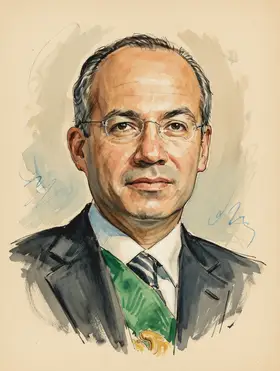
Felipe Calderón
63 years old·Citizens' Movement·Former President of Mexico
- Known for
- 63rd president of Mexico, War against drug cartels
- Born in
- Morelia, Mexico
- Education
- Master of Public Administration, John F. Kennedy School of Government at Harvard University
Felipe Calderón is a Mexican politician and lawyer who served as the 63rd President of Mexico from 2006 to 2012, rising through the ranks of the National Action Party (PAN). His presidency is primarily defined by the controversial escalation of the War on Drugs against cartels, a defining security policy of his term.
Signature Positions
Calderón's presidency and political views focused on economic liberalization and a decisive security posture:
- War on Drugs: Declared war on drug cartels shortly after taking office, launching Operation Michoacán with significant federal force deployments.
- Economic Policy: Advocated for free trade, balanced fiscal policies, and attracting foreign investment, resulting in significant infrastructure projects like the Baluart Bridge.
- Social Views: Identified as pro-life but supported limited abortion access in specific cases, and advocated for the legalization of small drug quantities for addicts in treatment.
- Infrastructure: Accelerated public works projects, overseeing the creation of extensive interstate highways and promoting investment in green technology.
Notable Tensions
Calderón's legacy is complicated by several significant controversies and policy outcomes:
- Drug War Violence: While detaining top drug lords, his military strategy coincided with a sharp rise in homicides, leading to widespread insecurity and official deaths exceeding 60,000.
- Security Corruption: His term was shadowed by allegations linking his Secretary of Public Security, Genaro García Luna, to the Sinaloa Cartel, resulting in García Luna's later conviction in the U.S.
- Political Legitimacy: He took office with the narrowest margin in Mexican history following a contentious 2006 election process disputed by the opposition.
- U.S. Espionage: His administration authorized U.S. surveillance systems for combating organized crime, but later discovered that the NSA had spied on him and his cabinet, leading to protests over institutional affronts.
How Views Have Evolved
Calderón's political journey involved a significant shift away from his roots:
- After three decades in the PAN, he left the party in 2018 to found his own political movement, Mexico Libre.
- His early domestic policies incorporated elements of his rival Andrés Manuel López Obrador's platform, such as the Tortilla Price Stabilization Pact, as an attempt to gain popular legitimacy early on.