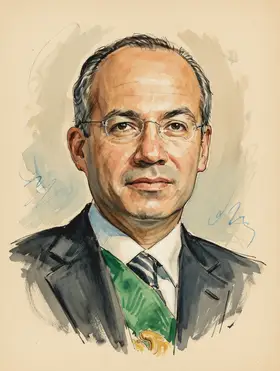
Felipe Calderón on Militarization of Security
TL;DR
Felipe Calderón initiated and massively expanded Mexico's militarized security strategy as the primary tool against organized crime.
Key Points
He announced the “joint operation in Michoacán” on December 11, 2006, deploying 5,000 soldiers to combat organized crime, marking the start of the frontal security policy.
His administration signed the Merida Initiative with the United States in 2008, which provided significant U.S. funds for military technology, weaponry, and training.
It is estimated that approximately 121,163 people were killed during the six-year term of Felipe Calderón's administration due to the security strategy.
Summary
Felipe Calderón's presidency, beginning in 2006, is marked by the decision to launch a massive, frontal militarized strategy against organized crime, often referred to as the "war on drugs." This policy involved the large-scale deployment of the Army and Navy into civilian security tasks, a framework that built upon prior incremental steps taken by his predecessors. The administration viewed organized crime as an imminent threat requiring the state's full force, leading to a significant increase in military operations across numerous states. This approach was institutionalized further through legal means, such as the interpretation of the National Security Law, and was internationally legitimized by the signing of the Merida Initiative with the United States in 2008, which provided significant military aid.
This strategy, however, is widely associated with negative consequences. Studies indicate that while the focus was on 'decapitating' cartel leadership, the militarized approach ultimately provoked an escalation of violence, fragmentation of criminal groups, and a notable increase in human rights abuse complaints against security forces. The policy also led to the prioritization of military over civilian security institutions, which experts argue is a symptom of a deeper civilian crisis of state capacity and accountability. The intense focus on military confrontation, rather than strengthening civilian police, became a defining, path-dependent feature of Mexican security policy, a trend later criticized by his successors for its perceived failure to bring lasting security improvements.
Key Quotes
more than 90% of the people who have died had a connection with one or the other band.
Frequently Asked Questions
Felipe Calderón's main security policy was the aggressive militarization of the state's efforts against organized crime, often termed the "war on drugs." He deployed the Army and Navy in unprecedented numbers to perform traditional policing duties across the country.
The former president justified the massive deployment of the military as a necessary response to what he termed an "imminent threat of organized crime on society." This rationale was used to authorize unilateral and permanent military operations in civilian security matters.
According to critical analysis, the militarized strategy pursued by Felipe Calderón did not achieve its security goals; violence and homicides rose to new highs during his term. The strategy is often cited as having fractured cartels and exacerbated conflict.
Sources9
Is Mexico's Security Policy Backfiring?
Why in Mexico have militarization and democratization been two sides of the same coin?
Mexican National Context
The perfect storm. An analysis of the processes that increase lethal violence in Mexico after 2006
The Human Costs of the War on Drugs. Attitudes Towards Militarization of Security in Mexico
Militarized security
Episode 26: Fuel to the Fire — None Of The Above
Militarized Security
The internal War
* This is not an exhaustive list of sources.