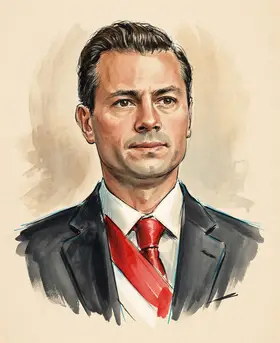
Enrique Peña Nieto on Institutional Revolutionary Party (PRI)
TL;DR
Enrique Peña Nieto represented the Institutional Revolutionary Party when he was elected President of Mexico in 2012.
Key Points
He was elected president in 2012 representing the PRI, which was running on the Compromiso por México platform with the PVEM.
Peña Nieto signed into law a constitutional change to overhaul the educational system in February 2013, which was part of his reform agenda agreed upon with other parties.
His chosen successor for the 2018 election, José Antonio Meade, was announced via the controversial 'El Dedazo' process, indicating a reliance on traditional PRI methods.
Summary
Enrique Peña Nieto held a strong, positive position on the Institutional Revolutionary Party (PRI), as he was the party's presidential candidate and subsequent president from 2012 to 2018. His candidacy succeeded after the PRI lost the presidency in 2000, marking a return to power for the party after a twelve-year absence. Peña Nieto campaigned on a platform that promised a new way of governing, aiming to honor the second chance granted by voters and distancing himself from the party's authoritarian past.
His presidency was characterized by pursuing structural reforms, such as in education and energy, often through a multi-party agreement known as the Pact for Mexico, involving the PRI, PAN, and PRD. While he sought to present a 'new face' of the PRI, his administration was also associated with controversial issues, including corruption allegations and the party's continued use of old-guard political tactics, such as the selection of his successor via the controversial dedazo. Despite these issues, his victory in 2012 was facilitated by voter disappointment with the preceding party's rule and a perception that the alternatives were weak.
Frequently Asked Questions
Enrique Peña Nieto was the standard-bearer and eventual president for the Institutional Revolutionary Party (PRI) from 2012 to 2018. His political career is inseparable from the party, as he won the presidency after the PRI lost power in 2000. His stance was highly positive, as he led the party's return to the highest office.
While Enrique Peña Nieto pledged to honor a new way of governing and distance himself from the party's past authoritarianism, his presidency was marked by both a commitment to structural reforms and the use of controversial, traditional PRI political methods. Opponents often portrayed him as the 'old PRI in disguise' despite his modern image.
As the PRI's presidential candidate, Enrique Peña Nieto won the 2012 election, leading the party back into the presidency after a 12-year absence. During his term, he implemented several structural reforms, like the education overhaul, but also faced significant public criticism regarding corruption within his administration.
Sources7
Enrique Peña Nieto's Candidacy Shows Its Vulnerabilities
Institutional Revolutionary Party summary
In Mexico, Old Party Gets New Chance | PBS News Hour Classroom
A Fall From Grace: A Look Back at Enrique Peña Nieto's Time in Mexico's Presidential Palace
Mexican President Peña Nieto's “Time of Troubles”
Enrique Peña Nieto (PRI-PVEM) | The Mexico Institute's Elections Guide
Institutional Revolutionary Party summary
* This is not an exhaustive list of sources.