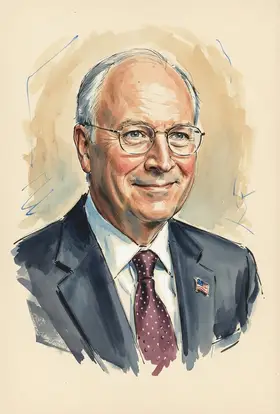
Dick Cheney on White House Chief of Staff
TL;DR
Dick Cheney views the White House Chief of Staff role as a critical, non-ceremonial gatekeeper position requiring significant government experience.
Key Points
Richard Cheney served as White House Chief of Staff for President Gerald Ford from November 21, 1975, to January 20, 1977.
He succeeded Donald Rumsfeld in the role after Rumsfeld was named Secretary of Defense.
Cheney's earlier service included the role of Deputy Assistant to the President for Ford starting in 1974.
Summary
Richard Cheney held the position of White House Chief of Staff for President Gerald Ford, beginning in November 1975 and serving until January 1977. His tenure in this role, which he assumed after serving as Deputy Assistant to the President, demonstrated an early commitment to executive branch management and shaping White House operations. During his time as Chief of Staff, he also managed Ford’s 1976 presidential campaign. Post-presidency recollections from former officials highlight that Cheney, due to his own experience in the role, understood the Chief of Staff as the gatekeeper who controls access and ensures the president’s time is used effectively. This historical experience informs the view that the position is crucial for operational effectiveness, especially for a president lacking deep Washington experience.
Frequently Asked Questions
Dick Cheney served as President Gerald Ford's White House Chief of Staff from late 1975 to early 1977, becoming the youngest person to hold the post at age 34. This role followed his service as Deputy Assistant to the President in the same administration. His service in this key operational role informs his later understanding of the position's significance.
Though not explicitly stated as an opinion on the role in the provided snippets, Cheney's extensive service in the role suggests he viewed it as highly important. Former colleagues later noted that Cheney understood the Chief of Staff as the essential 'gatekeeper' who manages the president's access and schedule. This contrasts with the generally ceremonial perception of the Vice Presidency that Cheney himself later countered.
Dick Cheney succeeded Donald Rumsfeld as White House Chief of Staff for President Gerald Ford. Rumsfeld had previously held the position before being appointed Secretary of Defense. Cheney was previously serving as Deputy Assistant to the President before assuming the Chief of Staff duties.
Sources7
A look at Dick Cheney's influential and polarizing legacy | PBS News
White House, Richard Cheney, White House Chief of Staff, Extracts of Handwritten Comments on a Draft of the Report to the President on the Commission on CIA Activities within the United States, circa June 1975.
Richard B. Cheney | Historical Office | Article View
President Ford and Vice President Cheney
Dick Cheney - Wikipedia
'By no means the malevolent force he was painted out to be' | Miller Center
Remarks at the Swearing-in Ceremony for Richard B. Cheney as Secretary of Defense
* This is not an exhaustive list of sources.