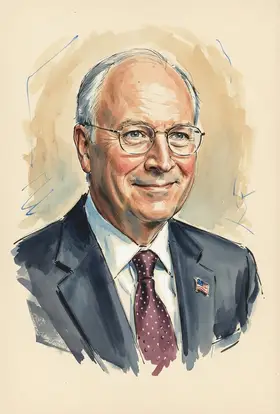
Dick Cheney on War on Terror
TL;DR
Dick Cheney viewed the War on Terror as an essential, winnable battle for the future of civilization against barbarism.
Key Points
He called the War on Terror a battle for the future of civilization that the U.S. would prevail in, as stated in a November 2006 address.
Cheney asserted that the only way to lose the fight against terrorism was to quit, a position he articulated in November 2005 regarding the Iraq front.
He was instrumental in post-9/11 policies that expanded executive power, including the use of enhanced interrogation techniques, and defended them as necessary for national security.
Summary
Dick Cheney considered the global conflict following the 9/11 attacks a critical struggle between civil societies and barbarism, asserting it was a battle worth fighting and one the United States was determined to win. He strongly defended the administration's strategy in Iraq, which he considered the central front, emphasizing the need to persevere despite setbacks and critics who called for withdrawal. He argued that retreat would only embolden terrorists seeking to wage war against free nations and establish a radical Islamic empire, making continued action vital for national security.
His position was deeply intertwined with his pre-existing commitment to an expansive view of presidential power, which he believed the War on Terror necessitated. The conflict provided the political context for asserting broad executive authority, exemplified by his role in authorizing domestic surveillance and denying Geneva Convention protections to detainees. Cheney operated with an exceptionally robust vice-presidential role, often shielding these expansive policies from conventional governmental and bureaucratic scrutiny.
Frequently Asked Questions
Dick Cheney strongly believed the War on Terror was an existential conflict, framing it as a necessary battle for the future of civilization against destructive barbarism. According to his remarks in 2006, he saw victory as certain if the nation did not quit the fight.
He justified intense measures, like controversial interrogation methods, by citing the unique and unprecedented nature of the threat posed by stateless terrorist networks after 9/11. Cheney argued in 2001 that protecting the nation against another attack required using any means at the government's disposal.
Yes, Dick Cheney faced significant criticism, particularly for his role in expanding executive power and the decision to invade Iraq based on contested intelligence. Analysis of his legacy suggests his actions in shaping counterterrorism policy may have paved the way for later political trends, according to a November 2025 report.
Sources5
Cheney Calls Terror War 'Struggle Between Civil Societies, Barbarism'
Analysis: Dick Cheney's role in 'war on terror' may have paved way for Trumpism
Vice President's Remarks on the War on Terror
Cheney, Vice Presidential Power and the War on Terror
CHENEY: War on terror is battle for future of civilization
* This is not an exhaustive list of sources.