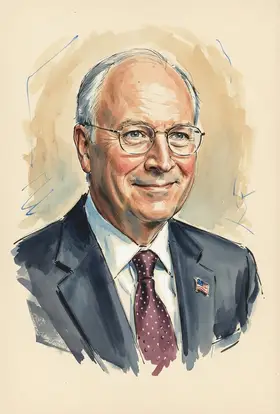
Dick Cheney on US Military Policy
TL;DR
Dick Cheney advocated deploying U.S. military personnel as warriors rather than peacekeepers, preferring robust force options.
Key Points
As Secretary of Defense in 1990, he emphasized a diplomatic strategy over considering 'military measures' against North Korea, as force discussions could jeopardize talks.
In a October 2000 debate, he stated a preference for deploying U.S. personnel as warriors rather than peacekeepers.
His post-Cold War influence contributed to a military buildup that funded both legacy systems and the Revolution in Military Affairs.
Summary
Dick Cheney's stated position on US military policy, as articulated during a 2000 vice presidential debate, favored utilizing American military personnel primarily as warriors rather than as peacekeepers in international conflicts. He suggested that when engaging in foreign issues, such as the situation involving Slobodan Milosevic in Yugoslavia, the preferred mode of deployment was in a combat or warrior capacity. This stance indicated a preference for decisive military action over extended peacekeeping operations.
This perspective contrasts with approaches that might prioritize multilateral diplomatic solutions or stabilization roles for the armed forces. Furthermore, evidence from the George H.W. Bush administration indicates that even then, as Secretary of Defense, Cheney rejected the option of military measures against North Korea when initial diplomatic strategy was in play. This suggests a calculus where military force is a powerful tool to be wielded decisively when policy demands it, but one that must be carefully sequenced to avoid undermining critical diplomatic efforts.
Frequently Asked Questions
Dick Cheney primarily favored a posture where the U.S. military acted as warriors, indicating a preference for decisive engagement over peacekeeping operations, according to a 2000 debate. However, his tenure as Secretary of Defense showed a willingness to keep military action as an option reserved to support, rather than undermine, active diplomacy, as seen in North Korea policy.
The provided sources suggest a consistent theme of valuing military capability as a primary tool of statecraft, both as Secretary of Defense and as Vice President. In the early 1990s, he cautioned against discussing military measures to protect diplomacy, while later, he publicly favored a warrior role for troops. This suggests an evolution in when to use the tool, rather than a change in belief in its importance.
In an October 2000 vice presidential debate, Dick Cheney addressed the situation involving Slobodan Milosevic in Yugoslavia. He indicated a desire for Russia to become involved in those problems. He also stated that he would rather see U.S. personnel deployed as warriors than in a peacekeeping capacity.
Sources4
Lieberman, Cheney differ on oil, military
Engaging North Korea: Evidence from the Bush I Administration
Return of the Iron Triangle
Insider : Presidential Timber? Cheney Lets Chips Fall as He Gains Stature : The defense secretary has gained global recognition as a warrior-diplomat. Even the Kremlin has offered a nudge toward the White House. - Los Angeles Times
* This is not an exhaustive list of sources.