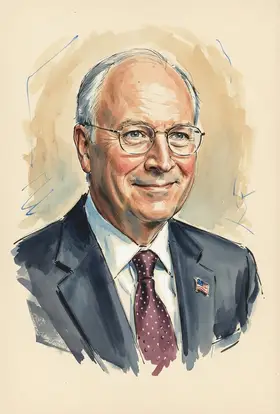
Dick Cheney on Halliburton
TL;DR
Dick Cheney's position on Halliburton is strongly positive due to his tenure as its former CEO and subsequent business benefits.
Key Points
He served as Chairman and CEO of Halliburton from 1995 until 2000, when he resigned to join the vice-presidential ticket [3, 4].
Under his leadership, Halliburton secured $2.3 billion in U.S. government contracts, nearly double the $1.2 billion earned in the prior five years [1].
Upon his departure in July 2000, the board allowed him to retain unvested stock options, which continued to vest according to the normal schedule [2].
Summary
Richard Cheney held the top executive roles at Halliburton, serving as CEO from 1995 until 2000, and later resumed the role of Chairman of the Board in February 2000 before leaving to join the presidential ticket [4]. During his five years leading the company, Halliburton significantly increased its contracts with the U.S. government, garnering almost double the amount it had earned in the preceding five years [1]. His tenure saw Halliburton jump from 73rd to 18th on the Pentagon's list of top contractors, benefiting from at least $3.8 billion in federal contracts and taxpayer-insured loans [6, 7].
Cheney's relationship with the company continued to be financially significant after his departure, as he maintained unexercised stock options worth millions, which continued to vest even after he became Vice President [3, 6]. Furthermore, his high-level access from his time as Secretary of Defense was perceived by analysts as a factor in Halliburton's ability to attract government contracts, with one official suggesting contracts would "go through the roof" if Cheney became Vice President [1]. His leadership at the company included overseeing a merger and changes in accounting practices, while the company was also linked to doing business with countries under U.S. sanctions, such as Iran [3, 7].
Key Quotes
the company's government contracts would obviously go through the roof.
Frequently Asked Questions
Dick Cheney was the Chairman of the Board and Chief Executive Officer of Halliburton, a role he held from 1995 until his resignation in 2000 [3, 4]. He resumed the role of Chairman in February 2000 before stepping down permanently for his vice-presidential role [4]. He was praised by the company for strengthening its strategies and increasing shareholder value during his tenure [2].
Yes, the former CEO retained significant financial interests in the company after becoming Vice President [6]. Specifically, he kept previously granted and outstanding stock options on 1,160,000 shares of common stock, some of which were unvested and continued to vest post-resignation [2, 3]. His income in 2000 was largely derived from a severance payment from Halliburton [3].
Dick Cheney's public statements and actions since leaving Halliburton suggest a very positive view, given his prior executive role and subsequent financial connection [6]. Although sources focus on his historical association, his continued financial ties imply a sustained, beneficial relationship with the company [3]. He was, however, associated with an administration that oversaw massive, no-bid contracts to Halliburton for work in Iraq [5, 7].
Sources8
Dick Cheney Resumes Role as Chairman of Halliburton Company
Cheney led Halliburton to feast at federal trough
Dick Cheney - Wikipedia
Dick Cheney's Halliburton
Cheney, Halliburton and the Spoils of War
Dick Cheney’s Houston legacy leaves a lasting mark
A Closer Look at Cheney and Halliburton
* This is not an exhaustive list of sources.