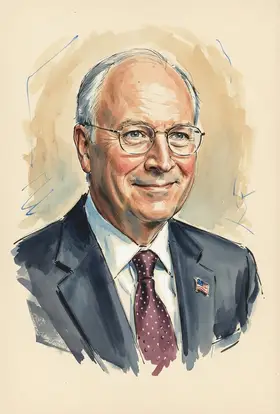
Dick Cheney
- Known for
- Most powerful vice president, architect of Iraq War, expanding vice presidential power
- Born in
- Lincoln, United States
- Education
- MA Political Science, University of Wisconsin–Madison
Dick Cheney served as the 46th Vice President, often characterized as the most powerful in U.S. history, deeply shaping the Bush administration's response to 9/11. Rising through every major government role, his tenure defined a proactive executive branch willing to employ significant military force globally. His influence on national security and presidential power remains his defining legacy.
Signature Positions
Cheney’s positions defined the post-9/11 era, particularly regarding foreign intervention and executive authority:
- Iraq War: Early, steadfast proponent, falsely alleging Weapons of Mass Destruction and operational links with Al-Qaeda to justify the invasion.
- War on Terror: Heavily promoted enhanced interrogation techniques (torture) and NSA warrantless surveillance to combat terrorism.
- Executive Power: Championed the unitary executive theory, actively seeking to restore presidential authority challenged since the Watergate era.
- Defense Policy: Oversaw military downsizing post-Cold War while planning for U.S. military dominance in the new era.
- Same-Sex Marriage: Surprisingly supported same-sex marriage personally, though insisting it was a matter for states to decide.
Notable Tensions
Cheney's career is marked by significant controversies and complex political alignments:
- War Justifications: Widely criticized as the chief architect of the Iraq War based on intelligence that was later discredited.
- Corporate Ties: His leadership at Halliburton before the VP term raised concerns about conflicts of interest, especially regarding post-war contracting.
- CIA Leak Scandal: His office was central to the investigation involving his former chief of staff, Lewis 'Scooter' Libby, regarding the outing of CIA operative Valerie Plame.
- Post-Presidency Shift: Despite early support for Donald Trump in 2016, he later became a vocal critic after the January 6 Capitol attack, endorsing Kamala Harris in 2024.
Cheney transformed the role of the Vice Presidency into a center of policy power, described as being 'almost coequal of, the presidency itself.' His influence over defense and foreign policy decisions during the George W. Bush administration was unprecedented. Globally, he is often viewed negatively, associated with the excesses of the War on Terror and policies criticized as violating international law.