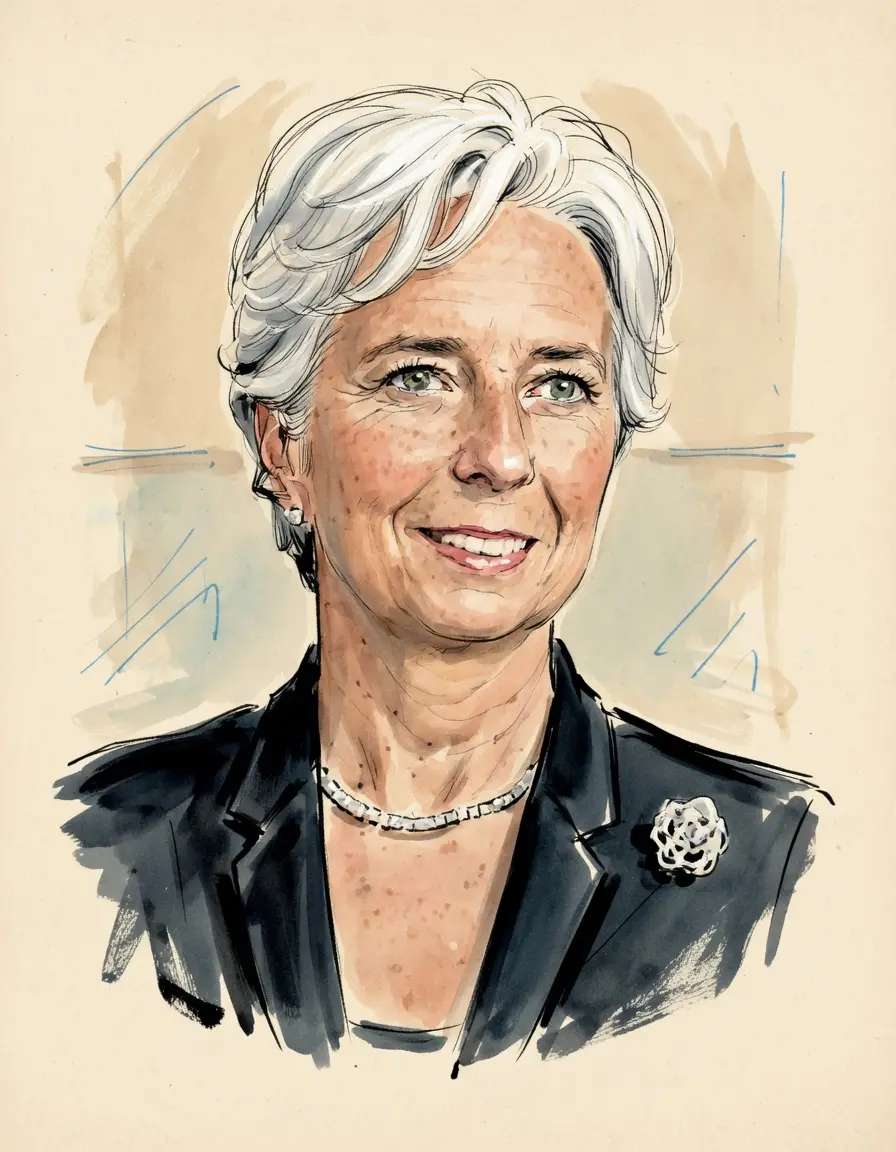
Christine Lagarde on Tariffs
TL;DR
Christine Lagarde views tariffs as a negative force that risks upsetting the global economic equilibrium and undermining growth worldwide.
Key Points
She warned in September 2025 that US tariffs risked upsetting the equilibrium within the European Union and the global economy.
Tariffs were identified as one of the key issues, alongside the war in Ukraine, that the European Central Bank would consider when meeting to discuss interest rates in April 2025.
Lagarde suggested that for the euro area to offset the expected decline in exports to the US due to tariffs, a 2% increase in intra-euro area trade would be required.
Summary
Christine Lagarde has consistently voiced strong apprehension regarding the imposition and escalation of tariffs, viewing them as a primary symptom of detrimental geoeconomic shifts. She noted that the imposition of significant tariffs by a major trading partner in 2025 triggered trade uncertainty and exchange rate swings, despite initial model predictions regarding retaliation and inflation not fully materializing as expected. The President of the European Central Bank has indicated that tariffs are generally negative for euro area growth and that, in the current geopolitical climate, trade is being deployed as a tool of power rather than merely economic protectionism.
She has framed the current era as moving from calculable risk to Knightian uncertainty, where trade policy is increasingly used as a geopolitical instrument, forcing policymakers to adapt their frameworks. While the initial inflationary impact of tariffs in 2025 was contained by factors like a stronger euro and a lack of significant reciprocal retaliation, she warned that sustained trade pressures are likely to weigh negatively on potential growth. Lagarde has emphasized that to counteract these external forces, internal policy responses like deepening the Single Market are crucial to boost intra-euro area trade and maintain economic momentum.
Key Quotes
Trade policy is increasingly used as a geopolitical instrument, with tariffs and restrictions affecting a growing share of global commerce.
Frequently Asked Questions
Christine Lagarde's position on tariffs is one of strong opposition, viewing them as a negative factor for global economic health. She has stated that tariffs are a tool of power that risks upsetting established economic equilibrium. Her assessment is that such trade barriers primarily exert an adverse effect on growth rather than creating significant new inflationary pressures.
While the specific economic modeling of tariff impacts has evolved with new data, Christine Lagarde’s fundamental stance against trade wars has remained consistent. She has characterized the latest round of tariffs as a symptom of a broader geopolitical shift. Her focus has been on how the economic reality of tariffs differs from initial model predictions, not on changing her opposition to them.
In late 2025, Christine Lagarde noted that the expected major adverse shock from US tariffs had not fully materialized as predicted by early models. Specifically, she observed limited retaliation and an appreciating euro, which contained imported inflation from supply chains. However, she maintained that the cumulative impact of tariffs and uncertainty was still expected to be a negative drag on euro area growth.
Sources5
Trade wars and central banks: lessons from 2025
From risk to uncertainty: Lagarde's message at Johns Hopkins
Christine Lagarde: Tariffs will be negative the world over
Lagarde Says US Tariff Moves Risk Upsetting Equilibrium With EU
Global economy: Trump tariffs, ECB's Lagarde
* This is not an exhaustive list of sources.