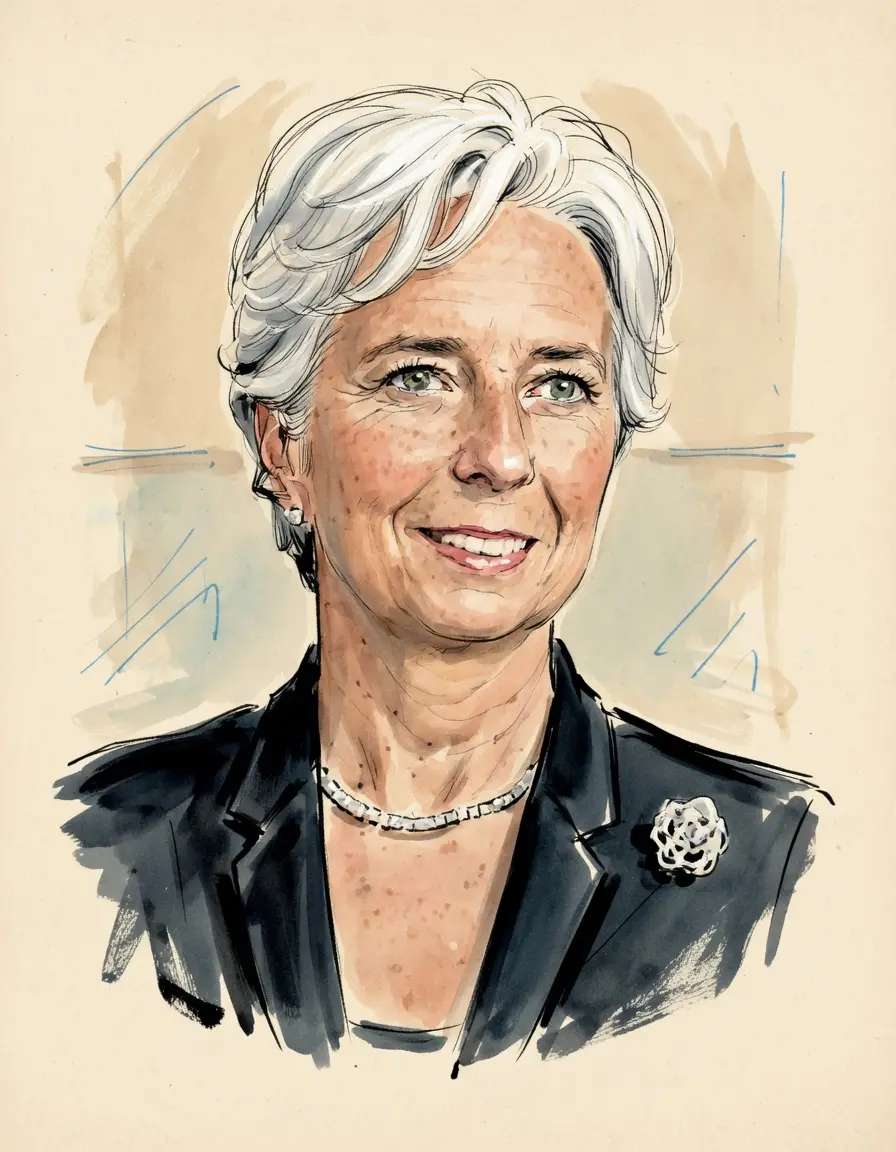
Christine Lagarde on Global Economy
TL;DR
Christine Lagarde stresses the global economy is shifting from calculable risk to uncertainty, requiring policy adaptation and cooperation.
Key Points
As IMF Managing Director, Christine Lagarde stated in April 2019 that the global economy was at a delicate moment with 70 percent of it facing a slowdown.
She asserts the current global order is fracturing, with multilateral cooperation being replaced by zero-sum thinking and protectionism.
Lagarde advocates for a policy response involving reforming global institutions, deepening cooperation among allies, and maintaining basic cooperation with rivals to foster 'resilient integration'.
Summary
Christine Lagarde has characterized the global economy as being at a delicate moment, observing a shift from an era of synchronized growth acceleration to a period where seventy percent of the global economy is expected to experience a slowdown, though she currently does not foresee a near-term recession. Her core position emphasizes that the stability underpinned by multilateralism and a rules-based system is fracturing, with protectionism and trade policy uncertainty replacing established norms. This transition is moving the system from manageable risk, which can be measured and priced, toward genuine uncertainty, where historical data becomes less reliable due to forces like geopolitical fragmentation and rapid technological disruption, such as artificial intelligence.
She argues that this evolving landscape presents significant risks, especially for highly integrated economies, but also potential opportunities, such as an increased international role for the euro. To navigate this, Lagarde outlines a policy response focusing on three layers: reforming global institutions like the IMF, deepening cooperation among trusted allies on critical issues, and maintaining minimum necessary cooperation even among geopolitical rivals. Her view implies that avoiding a detrimental outcome, where fragmentation stifles progress, depends on pursuing what she describes as resilient integration, echoing historical lessons about addressing instability to sustain trade.
Frequently Asked Questions
Christine Lagarde believes the global economy is transitioning from a period of calculable risk to one defined by genuine uncertainty. She sees downside risks stemming from geopolitical fragmentation and trade policy tensions, necessitating careful handling and policy coordination.
Christine Lagarde frequently highlights risks such as geopolitical uncertainties, including trade tensions and events like Brexit, alongside high debt in certain sectors. She warns that these factors make the expected rebound in global growth precarious.
Christine Lagarde has proposed a three-layer approach for managing uncertainty, which involves reforming global institutions like the WTO and IMF. Furthermore, she urges deepening cooperation among allies while maintaining minimum cooperation even with geopolitical competitors.
Sources4
IMF / LAGARDE GLOBAL ECONOMY | UN Audiovisual Library
Christine Lagarde: Earning influence - lessons from the history of international currencies
From risk to uncertainty: Lagarde's message at Johns Hopkins - Decode39
* This is not an exhaustive list of sources.