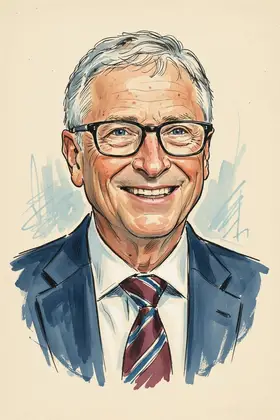
Bill Gates on AI and Jobs
TL;DR
Bill Gates views AI as increasing job efficiency first, eventually causing disruption that requires retraining and adaptation.
Key Points
AI is expected to increase productivity across many jobs in the next few years, similar to the PC revolution's impact.
He believes demand for roles focused on helping others, like teaching and caring for the elderly, will never disappear.
Governments and businesses must manage the transition by providing support and retraining for workers displaced by AI.
Summary
Bill Gates asserts that in the near term, the primary effect of artificial intelligence on work will be to enhance efficiency for workers across both manual and office roles. He suggests that as AI matures, it will take over tasks like writing emails and managing inboxes, ultimately giving people more time for other activities, both professionally and personally. He notes that demand for roles centered on helping people, such as teaching and elder care, will persist.
He acknowledges that this AI-powered transition will be a bumpy one, comparable in scale to the introduction of the personal computer, which changed office work forever. Because of this impending shift, he stresses that governments and businesses have a role in managing the transition, ensuring workers receive necessary support and retraining to avoid the severe disruption experienced during the decline of manufacturing jobs. The overall effect, however, is viewed with historical optimism, framing it as a manageable societal adaptation to a transformative technology.
Frequently Asked Questions
Bill Gates sees AI initially boosting productivity across various job sectors, but he anticipates a significant disruption to the labor market over time. He believes that society must proactively manage this shift through retraining and policy adjustments to support displaced workers. He has expressed that roles involving human support will remain essential.
While the core message of technological transformation and resultant labor market shifts remains consistent with his views on past innovations, Bill Gates has emphasized the urgency of preparing for disruption in recent writings on AI. He noted that the rate of improvement in AI is starting to disrupt job demand in areas like software development faster than in some prior expectations.
According to some reports, Bill Gates stated that programming will remain a human endeavor, requiring creativity and judgment that AI cannot replicate, for at least a century. He suggests that AI will automate routine coding tasks, but complex problem-solving and innovation will keep human programmers in demand for a long time. This view contrasts with some other predictions about the speed of AI advancement in that specific field.
Sources7
The risks of AI are real but manageable
Bill Gates says AI can't replace programming — not even in 100 years. He believes this job will always need a human brain.
The one job ai won't take in 100 years is... Programming - Bill Gates
* This is not an exhaustive list of sources.