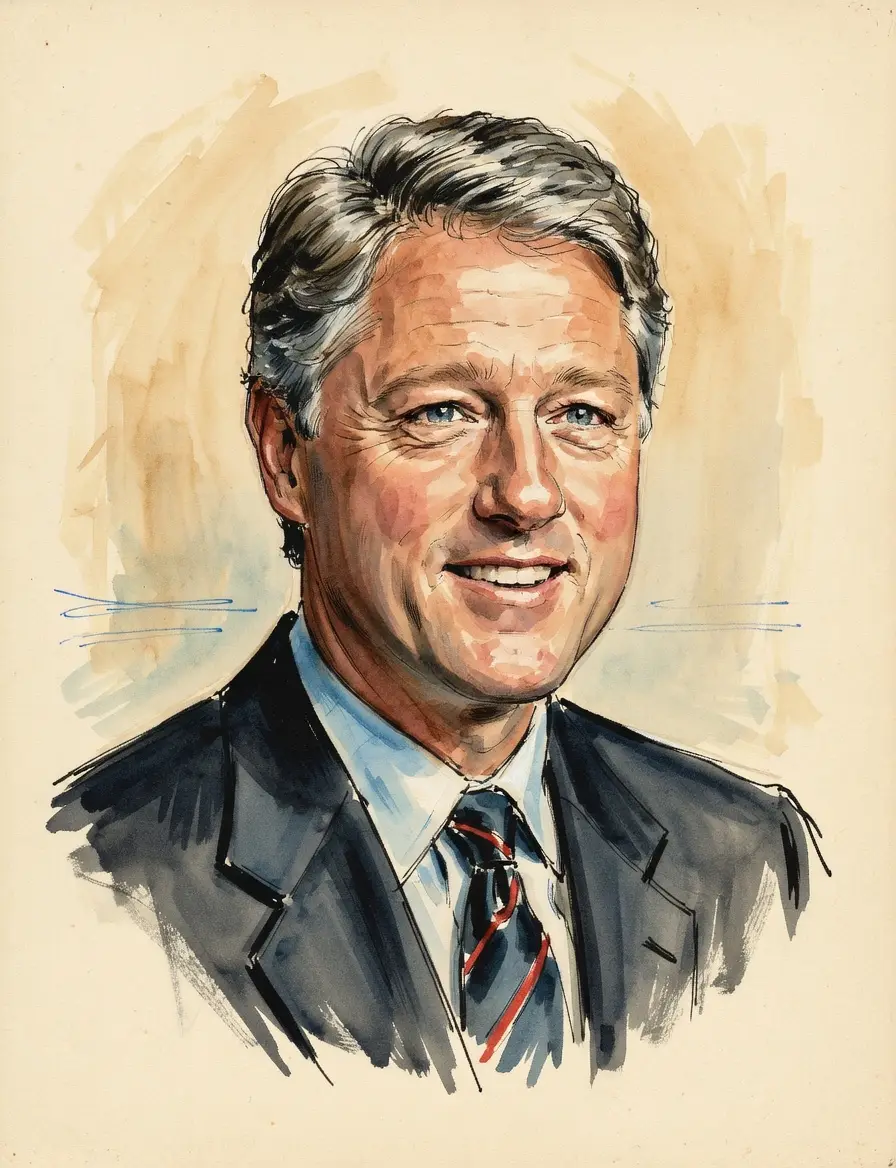
Bill Clinton on Free Trade
TL;DR
Bill Clinton strongly championed free trade agreements, viewing them as essential for national security and long-term prosperity.
Key Points
He signed the North American Free Trade Agreement (NAFTA) into law on December 8, 1993, eliminating most trade barriers with Canada and Mexico.
He pushed for and oversaw the ratification of the agreement creating the World Trade Organization (WTO) to replace GATT in 1995.
He lost a key legislative battle in 1997 when Congress denied his administration a renewal of 'fast track' authority for trade negotiations.
Summary
Bill Clinton strongly advocated for free trade policies, viewing them as central to a new era of global economic competition and national security. His administration's most significant legislative victory in this area was securing the passage and signing of the North American Free Trade Agreement (NAFTA) in 1993, which created a vast free trade zone between the United States, Canada, and Mexico. He also actively worked to conclude the Uruguay Round of the General Agreement on Tariffs and Trade (GATT), which established the World Trade Organization (WTO) and cut global tariffs substantially. The President argued that reducing foreign trade barriers was as crucial as traditional defense measures for building security and prosperity for Americans by expanding export markets.
Despite his firm stance, Clinton faced significant opposition, particularly from within his own party and labor unions, who feared job losses and depressed wages due to outsourcing. To counter these concerns, he negotiated labor and environmental side agreements for NAFTA and sought to create a robust worker training and retraining system, pledging that the gains from trade would extend to those who feared being burdened by competition. While he achieved major trade deals like NAFTA and permanent normal trade relations with China, he also suffered legislative setbacks, such as failing to secure renewal of 'fast track' negotiating authority in 1997, highlighting the domestic political difficulty of further liberalization.
Frequently Asked Questions
Bill Clinton's defining achievement in trade was signing the North American Free Trade Agreement (NAFTA) into law in 1993. This established the world's largest free trade zone at the time among the United States, Canada, and Mexico. He strongly believed this, alongside broader global trade liberalization, was key to future prosperity.
Yes, the President faced significant opposition, particularly from labor unions and many Democrats, who feared that agreements like NAFTA would lead to American jobs moving to countries with lower labor costs. To mitigate this, he included labor and environmental side agreements to his trade deals.
Yes, he continued to pursue trade liberalization, notably supporting the conclusion of the Uruguay Round of GATT, which created the WTO. Later in his presidency, he successfully championed a trade treaty with China, leading to its permanent normal trade relations status.
Sources8
Bill Clinton on Free Trade and Financial Deregulation (1993-2000)
Bill Clinton - Key Events | Miller Center
Economic policy of the Clinton administration - Wikipedia
Clinton signs NAFTA into law, Dec. 8, 1993
Clinton Loses 'Fast Track' Trade Bid - CQ Almanac Online Edition
NAFTA, Twenty Years After: A Disaster | Economic Policy Institute
Was Bill Clinton Also an “Extremist” on Trade? | Cato at Liberty Blog
* This is not an exhaustive list of sources.