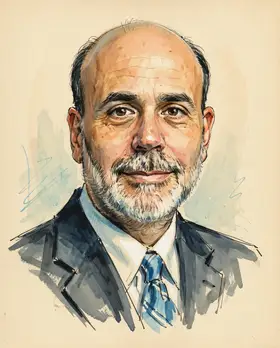
Ben Bernanke on Tariffs
TL;DR
Ben Bernanke views broad tariffs as economically damaging policies that distort markets and create long-term uncertainty.
Key Points
He joined a filing with a former colleague urging the US Supreme Court to review the legality of broad national security tariffs.
His academic research, dating back to the 1990s, focused on economic dynamics that generally support free trade principles over barriers.
Bernanke and other economists suggested that certain policy actions might not prove significantly inflationary despite concerns from others.
Summary
Ben Bernanke has expressed significant concern regarding the use of broad tariffs as an economic tool, particularly in the context of recent policy discussions. His core position aligns with mainstream economic thought, viewing tariffs as economically inefficient measures that raise costs for consumers and producers while distorting global trade patterns. Evidence for this stance comes from his involvement in legal and advisory contexts where he, alongside others, critiqued the economic justification for recent tariff actions, arguing they introduce unnecessary volatility into financial and commercial planning.
This perspective is rooted in his academic background, which emphasizes the benefits of open trade and market efficiency. The implications of employing tariffs, as he has indicated, extend beyond immediate price changes to include damaging long-term business investment decisions due to heightened policy uncertainty. He suggested that while specific, narrowly targeted trade remedies might be justifiable in rare instances, the sweeping nature of recent tariff applications undermines overall economic welfare and stability.
Frequently Asked Questions
Ben Bernanke holds a negative view of broad tariffs, which he has described as economically damaging policies that distort markets. He suggested that such measures introduce unnecessary volatility into both financial and commercial planning according to legal filings he supported.
Yes, the former Fed Chair vocally opposed the sweeping nature of the Trump administration's tariffs. He participated in an advisory action that panned the tariffs in a filing before the US Supreme Court, according to reports from late 2025.
The main critique from Ben Bernanke is that sweeping tariffs are economically inefficient because they raise costs for businesses and consumers, while also undermining long-term investment stability. He implied that the uncertainty created by these trade barriers outweighs any localized benefit.
Sources7
Trump Tariffs Panned by Bernanke, Yellen in Supreme Court Filing
The Effects of Tariffs on the U.S. Economy
Trump Tariffs Panned by Bernanke, Yellen in Supreme Court Filing
Trump Administration’s Tariff Threats Are Much More Than an Opening Gambit
Former Federal Reserve Chairs Ben Bernanke and Janet Yellen urged the US Supreme Court to review the legality of Trump’s tariffs on steel and aluminum
Trump's policies may not prove inflationary, Bernanke, others say
Trump Tariffs and US-EU Exit
* This is not an exhaustive list of sources.