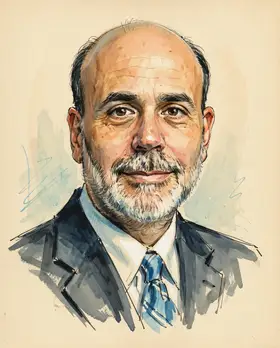
Ben Bernanke on Inflation
TL;DR
Ben Bernanke viewed pandemic-era inflation as primarily caused by supply chain kinks and commodity price spikes rather than just labor market overheating.
Key Points
He argued that the 2021-2022 U.S. inflation surge was overwhelmingly due to supply-side shocks like commodity prices and supply chain issues.
In a May 2022 keynote, the former Fed Chair addressed the determinants and consequences of inflation expectations on monetary policy choices.
Early in his Federal Reserve Chair tenure, he promoted adopting an explicit 2 percent inflation target, formalized in January 2012.
Summary
Ben Bernanke has analyzed the drivers of the U.S. pandemic-era inflation, concluding that the surge in 2021 and 2022 was principally driven by factors directly increasing prices, such as sharp rises in global commodity costs and sectoral price spikes due to supply chain disruptions and demand shifts toward goods. He and Olivier Blanchard found that while fiscal packages contributed to inflation via increased demand for limited supplies, the initial rise was not primarily due to upward pressure on wages from a tight labor market.
Although tight labor markets, measured by the job vacancy ratio, began playing a more significant role as supply shocks waned, the authors suggested that bringing inflation back to target would require balancing labor supply and demand. Bringing this balance requires either a reduction in job openings or improved labor market efficiency, which had been impaired by pandemic disruptions. He also examined the relationship between monetary policy and inflation expectations, emphasizing that expectations significantly influence financial conditions and behavior.
Frequently Asked Questions
In a 2023 paper, Ben Bernanke indicated that the recent surge in U.S. inflation was primarily caused by supply-side factors, such as global commodity price hikes and supply chain problems, rather than being driven by an overheated labor market initially. He noted that fiscal policy did play a role through increased demand for constrained goods, according to his analysis.
Yes, Ben Bernanke believes that inflation expectations play an important role in determining financial conditions and general behavior, as stated in a May 2022 keynote address. He examined how expected inflation impacts central bank policy choices and vice versa. His past work also shows a strong belief in using inflation targeting as a framework for monetary policy.
Ben Bernanke was a prominent proponent of adopting an explicit inflation target while at the Federal Reserve, viewing it as a framework to improve policy effectiveness. He supported formalizing the 2 percent inflation goal, which the Federal Open Market Committee eventually adopted in January 2012. This reflects his academic work advocating for inflation targeting.
Sources5
What caused the U.S. pandemic-era inflation? | Brookings
Ben Bernanke's lessons from the Great Inflation
Ben Bernanke: Solving a Crisis, Changing the Fed - San Francisco Fed
2022, Inflation Expectations: Determinants and Consequence - Keynote, Ben Bernanke, "Inflation Expectations and Monetary Policy" | NBER
Bernanke and Blanchard's Obsession with the Wage-Price Spiral | Institute for New Economic Thinking
* This is not an exhaustive list of sources.