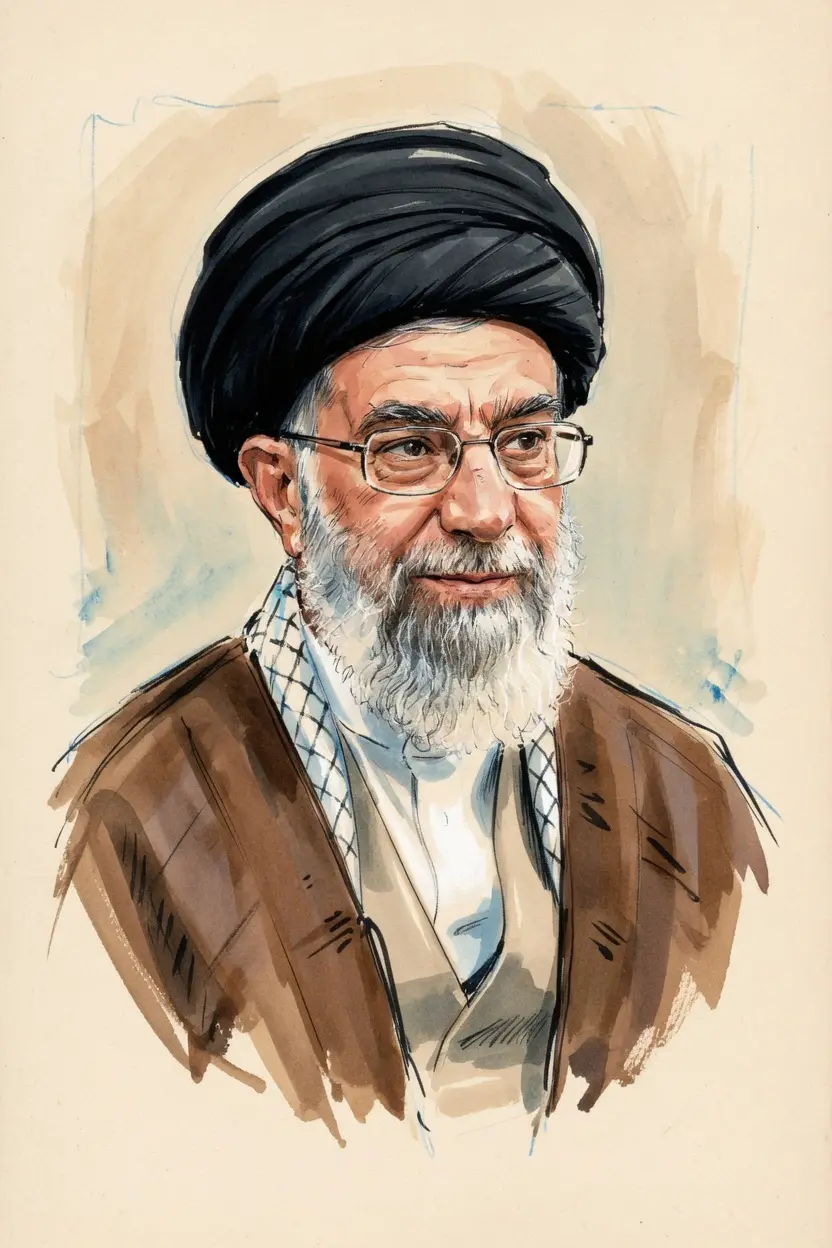
Ayatollah Ali Khamenei on Ruhollah Khomeini
TL;DR
Ayatollah Ali Khamenei succeeded Ruhollah Khomeini, adopting his theory of Velayat-e Faghih and continuing his revolutionary principles.
Key Points
He studied at the seminary classes of Ruhollah Khomeini in Qom starting in 1958.
Khamenei succeeded Khomeini as Supreme Leader after his death in 1989, following a constitutional amendment.
The concept of Velayat-e Faghih, established by Khomeini, formed the basis for Khamenei's political authority.
Summary
Ayatollah Ali Khamenei’s position regarding Ruhollah Khomeini is one of profound ideological continuity and deep personal reverence, as Khamenei succeeded him as the second Supreme Leader of Iran in 1989. Khamenei studied under Khomeini in Qom, becoming an early political confidant and a key figure in the 1979 Iranian Revolution. He built his authority on Khomeini's foundational theory of Velayat-e Faghih, or rule by a jurist, skillfully combining this with cultural notions of kingship resonant in Iranian culture.
The implications of this stance are that Khamenei positioned himself as the guardian and implementer of Khomeini's legacy, inheriting the mantle of spiritual and political authority. The transition involved a constitutional amendment to remove the requirement that the Supreme Leader be a Grand Ayatollah, a change which facilitated Khamenei's succession after Khomeini’s death. Khamenei consistently promoted core revolutionary themes established by his predecessor, such as opposition to the United States and Israel, while wielding ultimate authority over all state branches.
Frequently Asked Questions
Ayatollah Ali Khamenei was a student of Ruhollah Khomeini in Qom and became his close political confidant. He ultimately succeeded Khomeini as the second Supreme Leader of Iran in 1989. This relationship positions Khamenei as the direct ideological heir to the founder of the Islamic Republic.
Following Ruhollah Khomeini's death, Ali Khamenei was elected by the Assembly of Experts on June 4, 1989. Because he did not initially meet the constitutional requirement of being a Grand Ayatollah, the constitution was subsequently amended to remove that requirement before he was reconfirmed.
Yes, Ayatollah Ali Khamenei strongly perpetuated the core ideology established by Ruhollah Khomeini, particularly the principle of Velayat-e Faghih, or rule by the jurist. His foreign policy of countering the United States and Israel also aligns with the revolutionary principles set forth by his predecessor.
Sources3
Real-Time Analysis: Ali Khomeini, Grandson of Regime Founder, Likely Next Supreme Leader
Ali Khamenei - Wikipedia
Iran postpones Khamenei's farewell as Israel threatens to kill successor
* This is not an exhaustive list of sources.