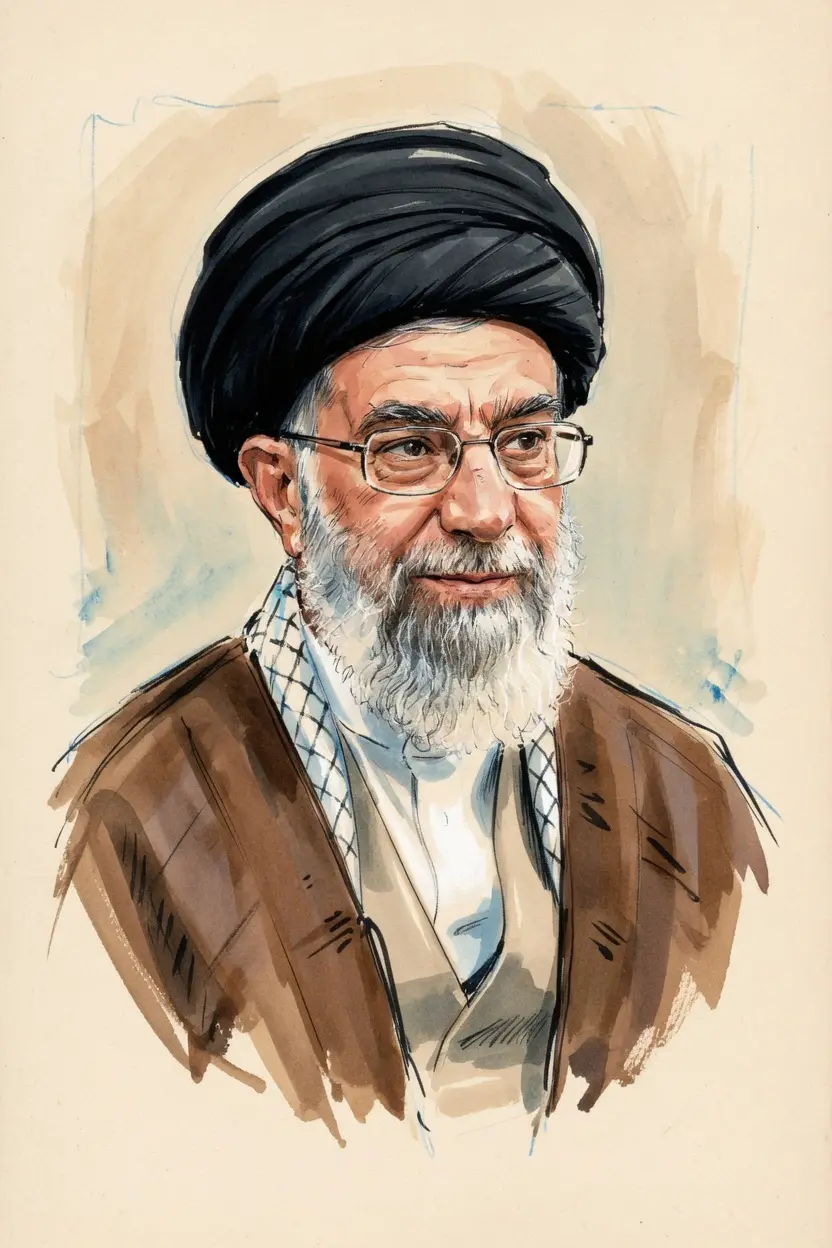
Ayatollah Ali Khamenei on Foreign Policy
TL;DR
Ayatollah Ali Khamenei prioritizes ideological resistance against US hegemony while maintaining tactical flexibility for national interest.
Key Points
He stated that the slogan “Death to America” is intended to mean only “Death to Trump, Pompeo and Bolton,” keeping the door open for future talks with the United States.
The Supreme Leader reiterated that Iran must be involved in key international economic and political developments while clearly identifying and countering threatening approaches from other countries.
He has indicated support for improving relations with neighboring Gulf states, as demonstrated by giving the green light to the China-brokered agreement with Saudi Arabia.
Summary
Ayatollah Ali Khamenei's foreign policy is fundamentally structured around an ideological rejection of what he terms the "forces of arrogance," primarily the United States and its allies, which he perceives as actively declining in global power. This worldview dictates an adherence to core revolutionary principles, viewing the world order as shifting away from unipolar American dominance toward a multipolar system where Iran should align with rising powers like Russia and China, a policy often summarized as "look to the East." He explicitly frames Iran's primary goals as removing external pressures and preserving the expansionist, ideological project of the Islamic Republic. Key to his strategy is the concept of "heroic flexibility," which permits tactical adjustments, such as engaging in diplomacy, if required by the higher interests of the Iranian state, as seen in past nuclear negotiations or recent regional de-escalation efforts.
This commitment to ideological resistance, however, is constantly balanced by pragmatic concerns, especially regarding domestic stability threatened by international pressure and sanctions. The Supreme Leader’s statements guide the entire foreign policy apparatus, unifying decision-makers like the Foreign Ministry and National Security Council under his ultimate vision, even if it means preparing the ground for potential concessions, such as on the nuclear file. While he champions strengthening allies and regional proxy groups to expand strategic depth, his policy also includes maneuvering to improve relations with neighbors like Saudi Arabia when deemed tactically necessary to overcome internal crises, suggesting that ideological goals can be momentarily sidelined for perceived immediate state interests.
Frequently Asked Questions
Ayatollah Ali Khamenei's foreign policy is fundamentally rooted in an ideological opposition to American hegemony, which he terms the "forces of arrogance." He directs the nation to pursue national interests by viewing the global system as shifting away from US dominance and toward new poles like China and Russia. He insists on ideological adherence while allowing for tactical flexibility when the higher interests of the state demand it.
While the core anti-American ideology remains constant, Khamenei employs a pragmatic approach labeled "heroic flexibility" that allows for tactical shifts. This has been seen in past nuclear negotiations and recent moves toward regional reconciliation, suggesting that while the long-term ideological goal is fixed, the methods employed can evolve based on internal and external pressures.
He maintains a stance of deep distrust toward the United States, often viewing US engagement as a ruse or evidence of an aggressive country on the verge of collapse. However, he has signaled that negotiations are not entirely out of the question, provided they are not with certain US leaders and serve Iran's interests, as seen in his comments after the 2015 nuclear deal.
Sources5
Features of Iranian Foreign Policy: A Reading of Khamenei's Speech
To Understand Iranian Foreign Policy, Look at Iran's Politics at Home
After Khamenei: Planning for Iran's Leadership Transition
The surreal experience of meeting Khamenei
How Iran's interpretation of the world order affects its foreign policy
* This is not an exhaustive list of sources.