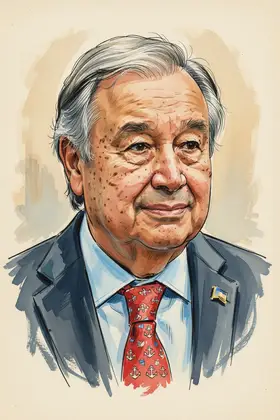
António Guterres on Iran
TL;DR
António Guterres strongly condemns military escalations involving Iran, demanding an immediate halt to hostilities and a return to diplomacy.
Key Points
He condemned the military escalation involving the US, Israel, and Iran on February 28, 2026, citing breaches of the UN Charter.
He strongly encouraged all parties to return to the negotiating table, noting that military action had squandered a chance for diplomacy.
His office stated that a congratulatory message sent to mark Iran's National Day was standard protocol and did not endorse government policies.
Summary
António Guterres firmly condemns recent military escalations in the Middle East involving the United States, Israel, and Iran, characterizing the exchanges as a grave threat to international peace and security. He has called for an immediate cessation of hostilities and de-escalation following joint US-Israeli strikes and subsequent Iranian retaliation across the region, emphasizing the risk of a wider conflict with grave civilian consequences. The Secretary-General repeatedly stresses that all Member States must adhere strictly to international law, particularly the UN Charter's prohibition on the use of force against another state's territorial integrity or political independence.
He views the military actions as having squandered an opportunity for diplomacy, especially after indirect talks had been underway, urging all involved parties to return immediately to the negotiating table. His position is rooted in upholding the UN Charter's foundational principles for resolving international disputes peacefully, including specific reference to the nuclear program's future in diplomatic discussions. While condemning attacks on Iran, he also condemned Iran's retaliatory actions for violating the sovereignty of several regional nations, maintaining a stance focused strictly on adherence to international law and civilian protection.
Frequently Asked Questions
António Guterres's main position is one of strong condemnation for the use of force by all parties in the recent escalation. He views these military actions as undermining international peace and security and explicitly calls for an immediate de-escalation.
Yes, he has strongly urged all parties to return to negotiations, specifically mentioning the future of Iran's nuclear program as a topic for the negotiating table. He also called for adherence to nuclear safety.
Yes, the Secretary-General received sharp criticism for sending a congratulatory message marking the anniversary of the 1979 Islamic revolution. Critics felt the gesture was tone-deaf given the UN's recent condemnation of Iran's crackdown on protesters.
Sources8
Statement by the Secretary-General on Iran | Secretary-General
Iran strikes 'squandered a chance for diplomacy': Guterres | The United Nations Office at Geneva
UN chief condemns U.S.-Israeli attacks on Iran during emergency Security Council meeting
UN chief blasted as 'abjectly tone-deaf' over message to Iran marking revolution anniversary
I condemn today’s military escalation in the Middle East
Secretary-General on Middle East
UN reaction following the attacks on Iran and retaliatory strikes
* This is not an exhaustive list of sources.