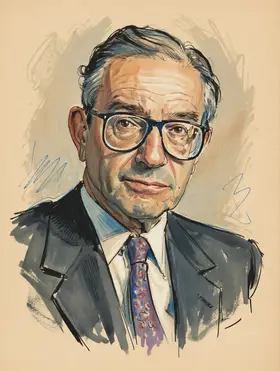
Alan Greenspan on Gold
TL;DR
Alan Greenspan strongly advocates for the gold standard as the only effective protector of savings against government-induced wealth confiscation.
Key Points
An early essay by Alan Greenspan stated that an almost hysterical antagonism toward the gold standard unites statists of all persuasions because it is incompatible with chronic deficit spending.
He later stated that gold is the primary global currency because it does not require a counterparty signature, unlike credit instruments or fiat currency.
Greenspan noted that the gold standard would have prevented the extreme indebtedness the U.S. reached, as it ensures fiscal policy does not get out of line.
Summary
Alan Greenspan's published views, particularly from the 1960s and 1980s, position gold as essential for economic freedom and sound money, viewing the gold standard as the superior monetary system. He argued that gold is the premier international currency because it is the only one not requiring a third-party guarantee, making it an intrinsic store of value that protects savings from inflation caused by government deficit spending. The gold standard, in this view, imposes necessary discipline on monetary authorities, preventing the unlimited expansion of credit that characterizes a fiat system and leads to wealth confiscation.
However, his tenure as Federal Reserve Chairman saw him operating within a fiat system, which some analysts suggest led to a softening or pragmatic shift in his stated positions while in office. While he later admitted that a gold standard would have prevented extreme indebtedness, he also suggested that central bank policy under fiat aims to follow the signals a gold standard would create. This implies a divergence between his philosophical ideal—a system where gold limits government—and his practical role in managing a system where political and economic realities necessitated flexibility away from a formal gold link.
Frequently Asked Questions
Alan Greenspan has historically been a strong advocate for the gold standard, viewing gold as the ultimate protector of property rights and savings against inflation. He argued that gold's objective value prevents governments from easily inflating the money supply to finance deficits. While his role at the Federal Reserve required operating under a fiat system, his foundational writings champion gold's indispensable role.
Analysts suggest his position has evolved from staunch advocacy for a formal gold standard to a more pragmatic view where central bank policy attempts to imitate its stabilizing signals. While the former Fed Chairman acknowledged that a gold standard would have prevented high debt levels, he also contended that his policies as Fed Chair tried to replicate the discipline a gold standard imposes.
Greenspan confirmed in 2014 that he believed gold is currently a good investment, especially when turmoil or questions about fiat currency credibility arise. He described gold as a currency that no fiat currency can match, noting that when serious questions emerge, the monetary component of its price drives it upward.
Sources8
Greenspan and Gold
Gold & Economic Freedom - an Article by Alan Greenspan (1966)
Gold & Economic Freedom - an Article by Alan Greenspan (1966)
In 1967 Alan Greenspan argued in his "Gold and Economic Freedom" that unbacked currency, deficit spending and intentional inflation are tantamount to wealth confiscation. Twenty years later, he was chairman of the Fed. How and why did his views change? Did he write about it? : r/AskEconomics
Alan Greenspan, WSJ, 1981: “Can the U.S. Return to a Gold Standard?”
Alan Greenspan Quotes About Gold | A-Z Quotes
Alan Greenspan Thinks That Gold Is Currently a Good Investment
Alan Greenspan Admits Ron Paul Was Right About Gold
* This is not an exhaustive list of sources.