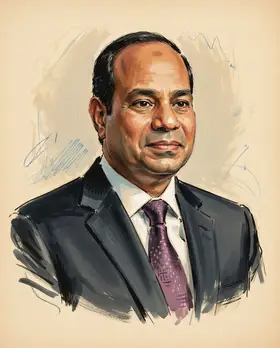
Abdel Fattah el-Sisi on Religion in Politics
TL;DR
Abdel Fattah el-Sisi advocates for a state-controlled, moderate form of Islam to counter extremism and safeguard the nation.
Key Points
He stated that his move to oust the former president was done "to protect Islam" from destructive religious ideas.
The government has actively worked to control religious institutions, including licensing imams to ensure state-approved sermons are delivered.
The political system established post-2013 explicitly prohibits the formation of political parties based on religion.
Summary
Abdel Fattah el-Sisi’s core position regarding religion in politics centers on establishing a state-managed, moderate version of Islam to act as a counter-discourse to what he views as the destructive religious ideas propagated by political-religious groups like the Muslim Brotherhood and Salafis. He has explicitly stated that his seizure of power was done in order to protect Islam from these perceived threats, positioning the state as the guardian of a tolerant religious path. This stance is evidenced by the government's efforts to exert control over religious institutions, including pushing for state-approved imams and sermons to curb independent religious discourse.
Following the 2013 military coup, the state's framework has emphasized secular political parties while simultaneously banning the most prominent Islamist political actor, the Muslim Brotherhood, which it designated as a terrorist organization. However, this move does not entirely remove religion from politics; rather, it attempts to reframe its role under state auspices, often co-opting other religious entities, such as the Salafi al-Nour party at times, to legitimize the exclusion of rivals. The overall implication is a desire for a politically compliant religious environment that supports state objectives of security and development, rather than one driven by independent religious political movements.
Frequently Asked Questions
Abdel Fattah el-Sisi seeks to subordinate religion to the state's authority by promoting a moderate interpretation of Islam. He frames this effort as a necessary war on terror and against extremist religious ideas that threaten national stability. This approach aims to prevent any independent religious political movements from gaining traction.
The government, under President Abdel Fattah el-Sisi, officially designated the Muslim Brotherhood as a terrorist organization and banned its political wing. This action was a core element of securing the post-2013 political order. While this excludes one major Islamist group, the state continues to engage with and attempt to control other religious political actors.
While the political system bans parties based on religion, Sisi's focus is more on controlling the discourse of Islam than on complete secularization. He speaks of "state Islam" as a counter to political Islam, indicating a desire to manage religion's public expression rather than fully separating it from the state. His policies prioritize security and state ideology over liberal pluralism.
Sources4
Profile: Sisi, a man for all seasons? | News | Al Jazeera
Three observations on religion, politics, and the Muslim Brotherhood – The Immanent Frame
Egypt | Wilson Center
Politics of Egypt - Wikipedia
* This is not an exhaustive list of sources.